Alternate title 1: 25 Metaphors for Animals and What Each One Means
Alternate title 2: Metaphor for Animals: Meanings, Examples, and Poem Ideas
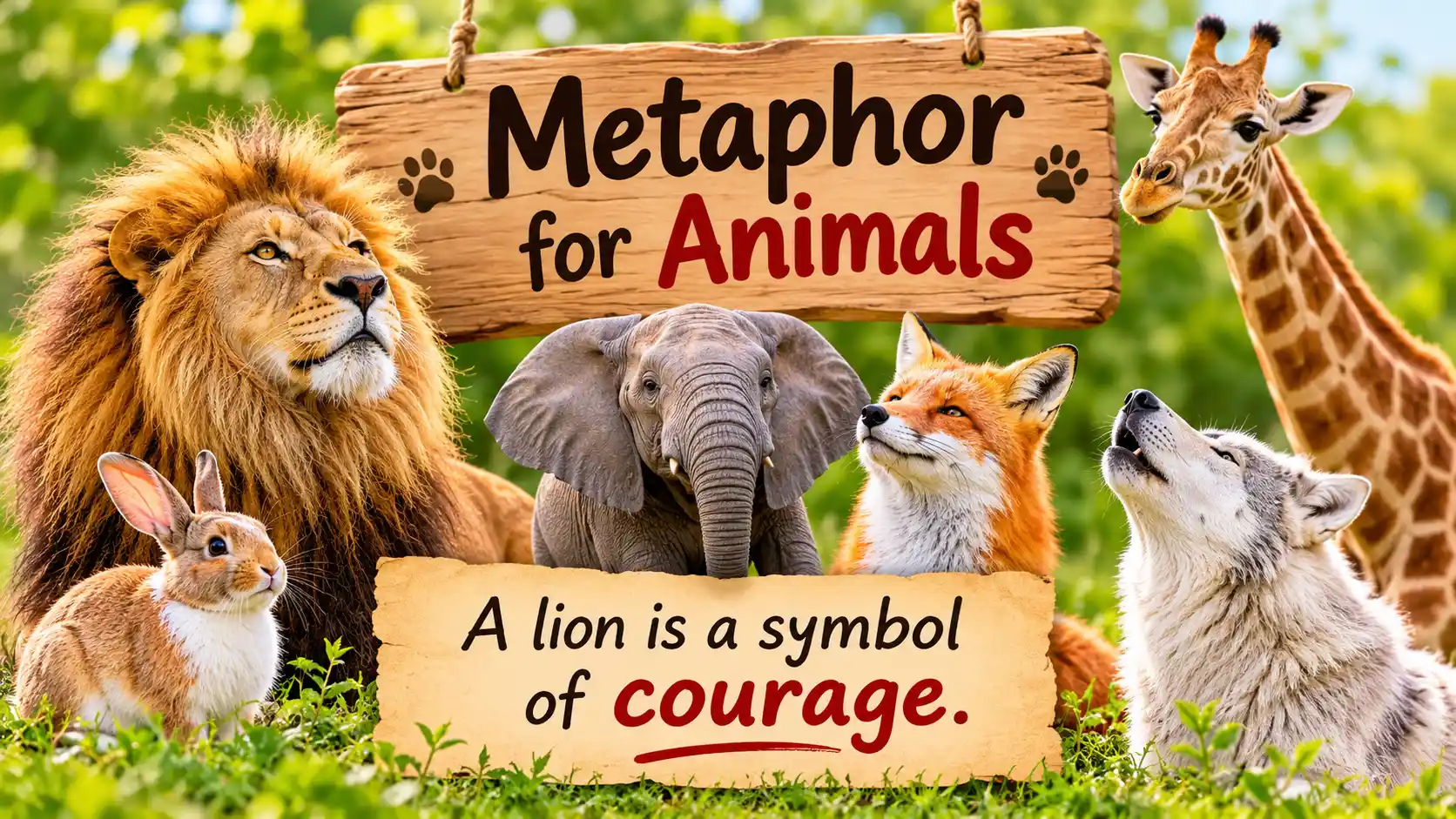
A metaphor for animals describes a creature, or the animal kingdom, by comparing it to something else. Man’s best friend carries loyalty, a wild heartbeat suggests freedom, a gentle giant shows soft strength, and a velvet shadow brings quiet grace. Such images help readers feel what an animal means, not just what it looks like.
Strongest Metaphor for Animals
Animals are living mirrors. Their joy, fear, and affection show on the surface, so readers recognize their own feelings in them. This image works because it turns a creature into a reflection of the human heart. It feels honest, warm, and easy to use in almost any piece of writing.
Other strong choices include man’s best friend for loyalty, a wild heartbeat for freedom, a web of life for connection, a gentle giant for soft strength, and a velvet shadow for quiet grace.
Metaphors for Animals: 25 Examples and Meanings
This list mixes familiar expressions with fresh images, and originals are marked with (original).
| Metaphor | Meaning | Metaphor | Meaning |
|---|---|---|---|
| Man’s best friend | Loyal, loving companion | King of the jungle | Royal strength and pride |
| Ship of the desert | Endurance in harsh land | A gentle giant | Big strength, soft heart |
| Feathered friends | Birds as companions | A fur baby | Pet loved like family |
| A web of life | Everything connected | The circle of life | Birth, death, renewal |
| A living mirror (original) | Reflects human feelings | A wild heartbeat (original) | Untamed spirit |
| A four-legged shadow (original) | Constant, loyal presence | A velvet shadow (original) | Silent, graceful cat |
| A winged messenger (original) | News and freedom | A walking storm (original) | Raw, rolling power |
| A forest guardian (original) | Watchful protector | A fur-covered sunbeam (original) | Warmth and comfort |
| A tail-wagging sunrise (original) | Joyful welcome | A drifting mountain (original) | Calm giant of the sea |
| A flying flower (original) | Delicate, fleeting beauty | A tiny thunderstorm (original) | Small but fierce |
| A coiled spring | Ready, tense energy | A ghost of the forest (original) | Elusive, silent wildness |
| A pocket of sunshine (original) | Small joy, big comfort | A teacher without words (original) | Quiet life lessons |
| A wild song (original) | Voice of nature | A living bridge (original, bonus) | Link to the natural world |
Strong metaphors connect a concrete image with an emotional quality. Compare a gentle giant with a walking storm: one calms you, the other warns you. Likewise, a fur-covered sunbeam feels cozy, while a ghost of the forest feels distant and quiet. Each image tells readers exactly how to feel.
Metaphors for Animals and What They Express
Loyalty and Companionship
Use these images when you want readers to feel love, trust, and the comfort of an animal who stays close.
A dog is man’s best friend. This familiar phrase puts loyalty above everything else. It works because it treats the animal as a true friend, not just a pet.
Rosa’s old retriever, man’s best friend, waited by the door all day until she came home from the hospital.
A dog is a four-legged shadow. Shadows follow without being asked, and so does a loyal dog. Warm, constant, and a little funny, the picture sticks in the mind.
Wherever Daniel walked, his four-legged shadow padded along behind him.
A cat is a fur-covered sunbeam. Softness, warmth, and a patch of light on the couch come together in one image. Writers choose it for a pet that makes a room feel calmer.
Every afternoon the cat curled up on the windowsill, a fur-covered sunbeam with whiskers.
Wildness and Freedom
Choose these when an animal stands for the untamed side of nature.
A wolf is a wild heartbeat. The pulse suggests life that no fence can hold. Readers feel energy, danger, and freedom all at once.
Far up the ridge, the wolf was a wild heartbeat moving through the snow.
A deer is a ghost of the forest. Deer appear, pause, and vanish, so the image fits any creature that slips away unseen. Mystery and quiet come along with it.
At dawn, a ghost of the forest stepped into the clearing and then was gone.
A bird is a winged messenger. Birds cross borders and carry the feeling of news arriving. As a result, the image gives freedom a purpose.
The first robin of spring was a winged messenger, announcing that winter had finally lost.
Strength and Gentleness
These pictures help when a writer wants to show power wrapped in calm.
An elephant is a gentle giant. Size suggests strength, while the word gentle softens it. The pairing makes readers feel safe near great power.
The old elephant was a gentle giant, wading through the river with her calf.
A whale is a drifting mountain. Bulk and slow movement turn the sea into a landscape. Calm and awe rise together.
Beneath the boat, a drifting mountain rose, breathed out, and slid back into the blue.
A bear is a walking storm. Weather language hints at raw force that arrives without asking. Use it for power that deserves respect.
The bear crossed the creek, a walking storm in brown fur.
Nature and Connection
Pick these when the writing looks at animals as part of a larger living whole.
Animals are a web of life. Pull one thread and the whole web trembles. The image shows that every species supports another.
When the bees vanished from the valley, the web of life shook and the orchards went quiet.
Animals are a living mirror. People see their own joy, fear, and love in animal faces. Reflective essays often use this image to explore what creatures teach us about ourselves.
In the old shelter dog’s eyes, Maya found a living mirror of her own loneliness.
A heron is a teacher without words. Patience, stillness, and presence need no lecture. This image suits quiet, reflective writing.
The heron stood for an hour, a teacher without words about waiting.
Metaphors for Animals and Emotion
Animals show feelings in ways people understand at once. A wagging tail, a purr, or a flattened ear needs no translation.
Because of that, emotional metaphors for animals often borrow from weather and light. Sunrise, sunshine, and thunder give readers an instant sense of mood.
A happy dog is a tail-wagging sunrise. Morning light means a fresh start, and a wagging tail means welcome. Together they create pure joy.
Every evening at six, a tail-wagging sunrise greeted him at the door.
A tiny pet is a pocket of sunshine. The size feels small, yet the warmth fills a whole day. Use it for gentle comfort.
Her hamster was a pocket of sunshine on the worst Monday of the year.
A puppy is a tiny thunderstorm. Energy, noise, and sudden chaos arrive in a small body. Funny and affectionate, the image invites a smile.
The new puppy was a tiny thunderstorm, and the shoes never stood a chance.
A butterfly is a flying flower. Color and delicacy drift through the air together. It suits moments of fragile beauty.
A flying flower landed on her wrist and stayed for one breath.
Positive and Negative Metaphors for Animals
Not every metaphor for this topic is warm or kind, and writers also use darker images.
- Man’s best friend: loyal, loving, and always nearby
- A gentle giant: soft heart beneath great size
- A fur-covered sunbeam: warmth and comfort at home
- A web of life: all creatures linked together
- A pocket of sunshine: small joy that brightens everything
- A walking storm: raw power that frightens others
- A coiled spring: danger waiting to be released
- A caged heartbeat: wild life trapped and fading
- A cornered shadow: fear that turns into sudden defense
- A hunted ghost: fear, flight, and constant hiding
Fiction, poetry, memoir, and other emotional writing give darker images room to work.
Five Simple Metaphor Examples for Animals
These five are the easiest picks for an assignment, speech, or short piece of writing.
- Man’s best friend: loyal companion who stays close
- King of the jungle: proud, powerful leader
- A gentle giant: great strength, soft heart
- A web of life: all nature connected together
- A living mirror: reflects human feelings back
Together, the five cover different meanings instead of repeating one idea.
Metaphors for Pets
Pets live inside our homes, so the best images feel warm, close, and a little playful. Think of light, comfort, and family rather than danger. Short, friendly phrases work best, since pets are loved like family members. Keep the tone affectionate, and let the animal’s habits, like purring or tail wagging, supply the detail.
- A fur baby: pet loved like family
- A fur-covered sunbeam: warm, sleepy comfort
- A four-legged shadow: constant, loyal company
- A pocket of sunshine: small joy, big comfort
- A tail-wagging sunrise: joyful welcome home
Our cat is a fur-covered sunbeam, and the whole house relaxes when she purrs.
Metaphors for Wild Animals
Wild animals call for images of space, weather, and mystery. Because readers rarely meet them up close, a good metaphor can make a distant creature feel real. Lean on forests, storms, and mountains, and let silence do some of the work. For example, a mention of distance or stillness can show that these animals live by their own rules.
- A wild heartbeat: untamed life in motion
- A ghost of the forest: elusive, silent presence
- A walking storm: raw, rolling power
- A drifting mountain: calm, enormous giant of the sea
- A winged messenger: freedom crossing every border
The fox was a ghost of the forest, there at the edge of the headlights and then gone.
Animal Metaphor Poem Ideas
A poem works best when one central image carries the whole piece instead of a new comparison in every line.
Original example poem:
My dog is a four-legged shadow,
following me from room to room.
When the sun leaves, he stays,
a quiet dark that makes the dusk feel warm.
Night cannot separate us,
for he is always where I am.
The shadow image grows from following, to staying after sunset, to belonging wherever the speaker goes. Because every line returns to the same picture, the poem stays gentle and clear. A second poem could use a fur-covered sunbeam, shifting the focus from loyalty to comfort.
What Are Animals a Metaphor For?
Animals are a metaphor for freedom, loyalty, instinct, strength, innocence, and our own emotions. Which meaning appears depends on the story around the creature. A lion often points to courage and pride, while a lamb suggests innocence. Wolves can mean loyalty to a pack or danger at the door. Likewise, a caged bird can stand for lost freedom, even when no one says so aloud. Consider this line: The old dog slept by the stove, quiet proof that love does not need words. Here the dog carries comfort and devotion rather than wildness. Because the same animal can shift meaning, add one small clue, such as a place, a season, or a mood, so readers know which idea you intend.
What’s a Fancy Way of Saying Animals?
Several richer words can replace the plain one, depending on the mood you want.
- Creatures: warm, general, storybook feel
- Fauna: formal, scientific, collective
- Wildlife: neutral, natural, outdoor
- Beasts: poetic, old-fashioned, dramatic
- Critters: casual, playful, friendly
- Denizens: literary, rich, descriptive
- Animal kingdom: formal, broad, classic
- Menagerie: literary, a varied collection
Choose formal words for science and school, warm ones for personal writing, and poetic ones for verse.
What Are Some Idioms About Animals?
- Raining cats and dogs: raining very heavily.
- Let the cat out of the bag: reveal a secret.
- The elephant in the room: an obvious problem nobody mentions.
- A wolf in sheep’s clothing: danger hidden behind kindness.
- Curiosity killed the cat: too much curiosity brings trouble.
- The lion’s share: the largest part of something.
Metaphor vs. Simile for Animals
Metaphor: A cat is a fur-covered sunbeam.
Simile: A cat is like a fur-covered sunbeam.
A metaphor says the animal is the image, so the claim feels vivid and complete. A simile says the animal is like the image, which sounds softer and more careful. Choose a metaphor for punchy lines, and a simile when you want readers to compare gently.
Choosing the Right Metaphor for Animals
Choose the image according to the feeling you want the reader to experience.
| If animals mean… | Choose imagery such as… | Best for… |
|---|---|---|
| Loyalty and love | man’s best friend, a four-legged shadow | pet tributes, memoir |
| Comfort at home | a fur-covered sunbeam, a pocket of sunshine | cards, gentle blog posts |
| Wildness and freedom | a wild heartbeat, a winged messenger | poetry, nature writing |
| Mystery and silence | a ghost of the forest, a velvet shadow | fiction, atmospheric scenes |
| Power and size | a walking storm, a drifting mountain | adventure, descriptive essays |
| Soft strength | a gentle giant, a forest guardian | children’s stories, speeches |
| Connection in nature | a web of life, the circle of life | science writing, reflection |
| Human feelings | a living mirror, a tail-wagging sunrise | personal essays, emotional writing |
The strongest metaphor is the one that communicates the intended meaning without a long explanation.
FAQs
What is a good metaphor for animals?
A living mirror is a strong choice, because animals reflect human emotions so clearly. For loyalty, try man’s best friend. For wild freedom, a wild heartbeat works well. Choose the image that matches the feeling you want readers to carry away, then keep the rest of the sentence simple.
What are five metaphor examples for animals?
Five easy picks are man’s best friend, king of the jungle, a gentle giant, a web of life, and a living mirror. Together they cover loyalty, pride, soft strength, connection, and emotion, so your writing avoids repeating one idea. Each one also works well in a speech or short essay.
What are animals a metaphor for?
Animals often stand for freedom, loyalty, instinct, strength, and innocence. Their exact meaning depends on the story. A wolf may signal a loyal pack in one tale and danger in another, so context decides which idea the reader receives. Give readers a small clue to guide them.
What’s a fancy way of saying animals?
Creatures feels warm and storybook-like, fauna sounds formal, and wildlife feels outdoorsy. Denizens adds a literary touch, especially for forest or sea life. Pick your word by audience: scientists expect fauna, while children’s authors may prefer creatures. Poets often reach for beasts.
What is a good metaphor for pets?
A fur-covered sunbeam suits a cat that naps in a warm window, and a four-legged shadow suits a dog that follows you everywhere. For a playful tone, try a tiny thunderstorm for a puppy full of energy. Each one keeps the feeling affectionate and close to home.
What is a good metaphor for wild animals?
A wild heartbeat captures untamed life, while a ghost of the forest suits elusive creatures like deer. For large, powerful animals, a walking storm or a drifting mountain gives readers a sense of size and awe. Choose by mood: mystery, freedom, or raw power.
Final Takeaway
The strongest images are a living mirror for human feeling, man’s best friend for loyalty, a wild heartbeat for freedom, and a gentle giant for soft strength. For a poem, choose one animal and one image, then let them stay together from the first line to the last. In an essay, state the comparison plainly and add one sensory detail. For emotional writing, pick a small, specific moment, like a dog waiting at the door, so readers feel the meaning before they think about it. Above all, choose the metaphor that lets your reader feel what the animal means.

Abdullah writes about the quiet power of figurative language.
For him, a metaphor is not decoration — it is a bridge between hearts.
He built WishNeste to help every writer find the words they were searching for.