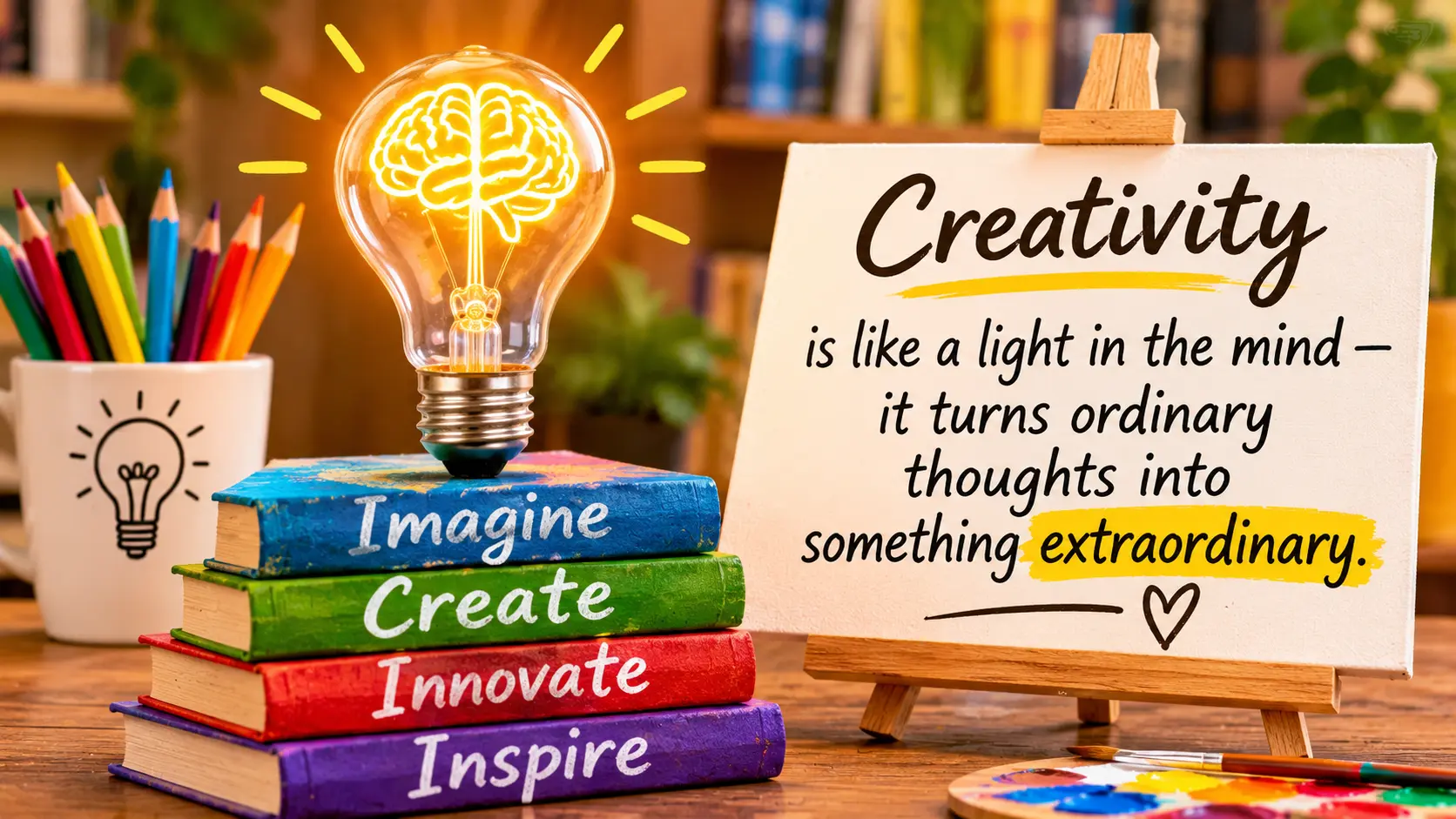
A metaphor for creativity describes the creative process by comparing it to something concrete. Writers often use a spark for sudden inspiration, a river for steady flow, a garden for patient growth, and a muscle for strength built through practice. Each image makes an invisible mental process feel easy to picture.
Strongest Metaphor for Creativity
Creativity is a river. It moves, finds new paths around obstacles, and never carries the exact same water twice. That is why the image works so well: it shows ideas as something alive and flowing, not something forced out of a locked box. Still, other images highlight different sides of the creative mind: a spark for the first flash of an idea, a garden for patience and care, a muscle for skill built through practice, a kaleidoscope for familiar pieces forming new patterns, and a compass for inner direction.
Metaphors for Creativity: 25 Examples and Meanings
This list mixes familiar expressions with original metaphors, and every original one is marked.
| Metaphor | Meaning | Metaphor | Meaning |
|---|---|---|---|
| A spark | Sudden new idea | A wellspring | Deep hidden source |
| A river | Steady flow | A garden | Patient growth |
| A muscle | Strength through practice | A seed | Hidden potential |
| A fire | Warm driving energy | A blank canvas | Open possibility |
| A door | Access to something new | A compass (original) | Inner direction |
| A kaleidoscope (original) | Familiar pieces, new patterns | A toolbox (original) | Skills within reach |
| An ocean | Endless depth | A bridge (original) | Connected ideas |
| A tide (original) | Rising and falling energy | A workshop (original) | Messy, hands-on making |
| A lightbulb | Instant insight | A thread (original) | Link across ideas |
| A storm | Wild, powerful energy | A window | Fresh point of view |
| A mirror | Reflection of self | A lantern (original) | Light in uncertainty |
| An unfinished map (original) | Unexplored territory | An orchard (original) | Slow, repeated harvest |
| A playground (original) | Free, curious play | Bonus: clay (original) | Shapeable raw material |
The strongest metaphors work because each one links a concrete image with an emotional quality. A spark feels sudden and exciting, while a garden feels slow and caring. In the same way, a storm suggests wild energy, but a lantern suggests calm guidance in the dark.
Metaphors for Creativity and What They Express
Sudden Ideas and Inspiration
These images fit the moment an idea arrives, so choose them when you want to show speed, surprise, or a flash of insight.
Creativity is a spark. One small flash can light a whole project, which makes the image feel quick and hopeful.
A spark in the shower turned into her first novel by spring.
Creativity is a lightbulb. This familiar picture shows an idea switching on all at once, bright and clear.
Halfway through the meeting, Maya’s mind clicked on like a lightbulb.
Creativity is a storm. Instead of a gentle flash, this image suggests ideas crashing in with thunder, noise, and force.
When the storm hit, Leo typed for three hours without looking up.
Flow and Energy
Pick these when you want readers to feel movement, heat, or the steady rhythm of working well.
Creativity is a river. Water keeps moving, bends around rocks, and carves new paths over time, so the image suits writers who feel in a groove.
Her mornings are the fastest stretch of the river, so she paints before breakfast.
Creativity is a fire. Fire gives warmth, light, and drive, yet it also needs fuel and air. Writers use it for passion that must be fed.
Feed the fire with books, long walks, and new faces, or it burns low.
Creativity is a tide. Rising and falling on its own schedule, a tide gives writers permission to rest when ideas pull back.
Some weeks the tide is out, so Carla sketches small and waits.
Growth and Patience
Slow images work best for projects that need time, care, and repeated effort before anything shows.
Creativity is a garden. Ideas need soil, water, and weeding, so this picture rewards patience and daily attention.
Tend the garden with ten quiet minutes of writing each morning.
Creativity is a seed. A tiny shell holds a whole plant inside, which shows potential that is not visible yet.
Every awkward first draft is a seed, so plant it anyway.
Creativity is an orchard. Trees give fruit season after season, but only after years of pruning. The image stands for creative work that pays off over a lifetime.
After twenty years of stories, his orchard finally fills baskets every fall.
Skill and Practice
Choose these when you want to say creativity is learned, built, and improved, not handed out at birth.
Creativity is a muscle. Muscles grow with use and shrink without it, so the image fits daily routines and creative habits.
Three pages a day made her creative muscle strong enough for a whole novel.
Creativity is a toolbox. Each tool, such as sketching or brainstorming, solves a different problem. The picture shows creativity as a set of skills you can reach for.
When Ben gets stuck, he opens the toolbox and tries free writing.
Creativity is a workshop. Noisy, messy, and full of half-finished work, a workshop honors the untidy middle of making things.
Her desk is a workshop, covered in sawdust made of crossed-out lines.
Connection and New Patterns
These images describe how a creative mind links old ideas into something new, which is often the heart of originality.
Creativity is a kaleidoscope. The same colored pieces turn into endless designs, so the image shows creativity as rearranging what you already know.
His mind is a kaleidoscope, turning old memories into fresh stories.
Creativity is a bridge. Two places that were separate become one route. The picture fits ideas that connect different fields, such as art and science.
Her work became a bridge between medicine and music.
Creativity is a thread. Scattered pieces become one cloth when a thread ties them together, which suits a theme running through many ideas.
One thread of curiosity ran through every project she ever made.
Metaphors for Creativity and Identity
For many artists, creativity is not only something they do. It is part of who they are, so the best images turn inward and ask where the work comes from.
Because of that, these metaphors often appear in memoirs, artist statements, and graduation speeches. They help a reader see the person behind the work.
Creativity is a mirror. Every piece a maker creates carries a reflection of the maker, so the image shows work and self as inseparable.
Her paintings are a mirror, and she finally likes the person looking back.
Creativity is a wellspring. Deep underground and never fully dry, a wellspring suggests an inner source that belongs to you alone.
Beneath the noise of daily life, his wellspring was always there.
Creativity is a window. Each window offers a view of the world through one pair of eyes, which stresses perspective and voice.
Her stories are windows, each one opening onto her grandmother’s kitchen.
Positive and Negative Metaphors for Creativity
Not every metaphor for creativity is warm or kind, because writers sometimes reach for darker images too.
Positive metaphors:
- River, steady and refreshing flow of ideas
- Garden, patient care and quiet growth
- Lantern, hope in uncertain, dark places
- Playground, joy, curiosity, and free play
- Kaleidoscope, color and endless new patterns
Negative or darker metaphors:
- Storm, overwhelming and hard to control
- Dry well, ideas feel far out of reach
- Locked door, blocked from the room you want
- Tangled thread, good ideas knotted together
- Low tide, energy pulled far away
Darker metaphors work best in fiction, poetry, memoir, and emotional writing, where a struggle needs a vivid picture.
Five Simple Metaphor Examples for Creativity
These five are the easiest picks for an assignment, speech, or short piece of writing.
- Spark: a sudden new idea
- River: steady, flowing ideas
- Garden: slow, patient growth
- Muscle: skill built by practice
- Compass: inner sense of direction
Together, these five cover different meanings instead of repeating one idea.
Metaphor for Creativity and Imagination
Imagination is the playful side of the creative mind, so reach for open, airy images that suggest freedom and wonder. Wide skies, open doors, and blank pages work well because they invite anything to happen. These pictures suit children’s stories, artist bios, and school essays. Heavy machine images can feel stiff here, so save them for other topics. Pick one image and stay with it.
- Playground, free and curious play
- Blank canvas, anything can still happen
- Open door, new worlds waiting inside
- Ocean, depth with no visible edges
- Kaleidoscope, ordinary pieces becoming wonder
In Nora’s mind, imagination is an ocean, and every wave carries a new story.
Metaphor for Creative Block
Creative block feels like being stuck, so the best images show something jammed, dry, or foggy. Then hint at a way forward. Pairing a dark image with a small fix makes the writing honest and hopeful at once. Seasons help too, because winter always ends. Readers who have felt stuck themselves will recognize the feeling right away, and that connection makes the metaphor stronger.
- Foggy road, direction exists but looks hidden
- Frozen river, flow paused, not gone forever
- Stalled engine, power waiting for the right spark
- Silent radio, signals out there, no reception
- Winter field, rest before new growth
Her frozen river finally cracked in spring, and the words came loose.
Creativity Metaphor Poem Ideas
A poem works best when one central image carries the whole piece, instead of a new comparison in every line.
Original example poem:
Creativity is a river, slow at the mountain’s feet, gathering every small idea that rain and doubt can bring. It bends around each boulder and learns the sea’s own song.
Here, the river grows as the poem moves. It starts as a trickle, collects ideas along the way, curves around obstacles, and finally reaches the sea. A writer could build a second poem on the garden, following one idea from seed to harvest.
What Does Creativity Symbolize?
Creativity symbolizes freedom, imagination, growth, individuality, and hope. Context decides which meaning rises to the top. In a school essay, creativity often stands for imagination and play. In a memoir, it can mean individuality, the one voice nobody else owns. During hard times, writers lean on it as hope, proof that something new can still be made. For example, a poet might describe a lit window in a dark city and let that small glow stand for the stubborn creative spirit. The same image would feel different in a story about a lonely artist, where it could suggest loneliness, not hope. Because of this flexibility, the word works as a symbol in almost every art form. Always ask which quality you want readers to feel, then pick an image that carries it clearly.
What’s a Fancy Way of Saying Creativity?
These alternatives sound more elegant or literary than the everyday word.
- Ingenuity, formal, clever, and practical
- Imagination, warm, playful, and open
- Inventiveness, neutral and full of energy
- Originality, formal and precise
- Artistry, poetic and refined
- Inspiration, warm and uplifting
- Resourcefulness, practical and down to earth
- Vision, poetic and forward-looking
Choose by tone: pick formal words for essays and reports, and warmer ones for letters, speeches, and personal stories.
What Are Some Idioms About Creativity?
- Think outside the box: come up with fresh, unusual ideas.
- The creative juices are flowing: ideas are coming easily right now.
- Break the mold: do something new instead of following the usual pattern.
- Necessity is the mother of invention: real need pushes people toward new ideas.
- Back to the drawing board: start a plan or design again after it fails.
Metaphor vs. Simile for Creativity
Metaphor: Creativity is a river.
Simile: Creativity is like a river.
A metaphor states the comparison directly, so it feels bold and confident. A simile adds like or as, which softens the claim and keeps the two things separate. Use a metaphor for strong, memorable statements, and a simile when you want a gentler or more careful tone.
Choosing the Right Metaphor for Creativity
Choose the image according to the feeling you want the reader to experience.
| If creativity means… | Choose imagery such as… | Best for… |
|---|---|---|
| Sudden inspiration | Spark, lightbulb | Short, punchy lines |
| A steady flow of ideas | River, tide | Reflective essays |
| Patient growth | Garden, seed, orchard | Speeches about long projects |
| Skill built through practice | Muscle, toolbox | Teaching and motivational talks |
| Messy making | Workshop, clay | Behind-the-scenes writing |
| New combinations | Kaleidoscope, bridge | Articles about innovation |
| Inner direction | Compass, lantern | Personal statements |
| Personal identity | Mirror, wellspring | Memoirs and artist bios |
| Open possibility | Blank canvas, door | Stories and school assignments |
The strongest metaphor is the one that communicates the intended meaning without a long explanation.
FAQs
What is a good metaphor for creativity?
A river is one of the best, because it flows, bends around obstacles, and keeps changing. If you want something quicker, a spark works well for a sudden idea. Choose a garden when your point is patience and steady care.
What are five metaphor examples for creativity?
Try a spark for a new idea, a river for steady flow, a garden for patient growth, a muscle for skill built through practice, and a compass for inner direction. Together, they cover different meanings, so you can match one to any assignment or speech.
What does creativity symbolize in writing?
In writing, creativity usually stands for freedom, imagination, and a personal voice. Depending on the story, it can also signal hope or growth. Readers decide the meaning from context, so surround the image with details that point toward the feeling you want.
What’s a fancy way of saying creativity?
Ingenuity, inventiveness, and originality are polished alternatives. Artistry sounds more poetic, while imagination feels warm and playful. Match the word to your tone: formal writing welcomes originality, and a heartfelt letter might prefer imagination. Each one shifts the mood slightly, so read your sentence aloud before you decide.
What is a metaphor for creativity in a poem?
Poets often pick one image and carry it through every line, such as a river that grows from a trickle into a sea. A garden, a lantern, or a kaleidoscope also work nicely. Keep the picture simple so the feeling stays clear.
Is “creativity is a river” a metaphor or a simile?
It is a metaphor, because it states that creativity is a river without using like or as. A simile would say creativity is like a river. Metaphors feel bolder and more direct, while similes feel softer and more cautious. Both are fine, so choose by tone.
Final Takeaway
Creativity gives writers many pictures to choose from. A river carries steady flow, a spark brings sudden excitement, a garden teaches patience, and a compass points toward your own direction. For a poem, build everything around one image and let it grow line by line. In an essay, pick a metaphor that matches your main argument and return to it once or twice. When writing about feelings, choose the picture that sounds most like the emotion itself. Whatever you choose, trust your own voice. The best metaphor is the one that makes your reader feel the meaning before you explain it.

Abdullah writes about the quiet power of figurative language.
For him, a metaphor is not decoration — it is a bridge between hearts.
He built WishNeste to help every writer find the words they were searching for.