Alternate title 1: Metaphors for Incredible: 25 Vivid Images and What They Mean
Alternate title 2: 25 Metaphors for Incredible Moments, With Meanings and Examples
A metaphor for incredible compares something astonishing to a concrete image that makes readers feel its wonder. Unlike plain synonyms for incredible, such as amazing or remarkable, a metaphor shows the feeling instead of naming it. Think a lightning strike (sudden awe), a sunrise over the sea (quiet wonder), a firework (bursting joy), or a mountain peak (towering greatness).
Strongest Metaphor for Incredible
Something incredible is a lightning strike. It works because the image holds three ideas at once: sudden arrival, enormous power, and a feeling that nobody could have predicted it. Readers sense the jolt before they read any explanation. Still, other images fit different moods. Try a sunrise over the sea for calm wonder, a firework for joyful excitement, a mountain peak for towering greatness, a shooting star for rare, fleeting moments, or an open door to another world for new possibility.
Metaphors for Incredible: 25 Examples and Meanings
This list mixes familiar expressions with fresh images, and the original metaphors are marked.
| Metaphor | Meaning | Metaphor | Meaning |
|---|---|---|---|
| a lightning strike | Sudden awe | a sunrise over the sea | Quiet wonder |
| a firework | Bursting joy | a mountain peak | Towering greatness |
| a shooting star | Rare, fleeting wonder | an open door to another world (original) | New possibility |
| a deep ocean | Vast mystery | a symphony | Layered beauty |
| a miracle | Beyond explanation | a rocket launch (original) | Powerful lift-off |
| a rare diamond | Priceless rarity | the northern lights | Glowing marvel |
| a thunderclap in a quiet room (original) | Shocking impact | a flood of light | Overwhelming brightness |
| a bridge to the impossible (original) | Doubt becoming real | a giant redwood | Ancient grandeur |
| a storm of color (original) | Wild beauty | a standing ovation (original) | Earned admiration |
| a wave that lifts you (original) | Carried by awe | a hidden treasure | Surprise discovery |
| a sky full of stars | Endless wonder | a roaring waterfall | Raw power |
| a skipped heartbeat (original) | Breathless reaction | a hot air balloon rising (original) | Weightless wonder |
| a once-in-a-century bloom (original) | Rare beauty | a feast for the eyes (bonus) | Visual delight |
The strongest metaphors work because each one ties a concrete image to an emotional quality. A lightning strike gives shock, while a sunrise over the sea gives calm. Likewise, a firework feels loud and joyful, but a hidden treasure feels private and surprising. Pick the image whose feeling matches your scene.
Metaphors for Incredible and What They Express
Sudden Shock and Surprise
These metaphors fit moments that hit without warning, and writers choose them when the reaction matters more than the scenery.
Something incredible is a lightning strike. One flash changes the whole sky, so the image suits news or events nobody saw coming.
The announcement was a lightning strike, and the whole room went silent.
Something incredible is a thunderclap in a quiet room. Silence makes the sound bigger. Here, the contrast creates the shock.
Her answer was a thunderclap in a quiet room.
Something incredible is a skipped heartbeat. This image moves the awe inside the body, where readers feel it directly.
When the final score appeared, the stadium shared one skipped heartbeat.
Something incredible is a firework. Sudden brightness and noise suggest delight rather than fear.
His surprise party was a firework over a dull winter night.
Beauty and Wonder
Choose these when the incredible thing is gentle, glowing, or too lovely to describe plainly.
Something incredible is a sunrise over the sea. Slow light spreads across calm water, so the image suits wonder that arrives quietly.
Her graduation day was a sunrise over the sea, slow, golden, and endless.
Something incredible is the northern lights. Colors ripple across the dark without a sound, which makes this ideal for beauty that seems unreal.
The dance recital was the northern lights, green and violet moving across a black stage.
Something incredible is a sky full of stars. Counting them is impossible, so the image shows wonder with no edge.
Their library was a sky full of stars, every shelf another light.
Something incredible is a once-in-a-century bloom. A flower that opens rarely draws a crowd, which fits beauty that cannot be repeated.
His voice was a once-in-a-century bloom, and the audience leaned in to see it.
Power and Greatness
Writers reach for these when size, force, or strength is what makes the moment unbelievable.
Something incredible is a mountain peak. Standing beneath one makes people feel small, so the image fits achievements that tower over everything nearby.
Her record was a mountain peak that no rival could see over.
Something incredible is a roaring waterfall. Constant force and noise show strength that cannot be stopped.
The crowd’s cheer was a roaring waterfall pouring over the field.
Something incredible is a giant redwood. Ancient and unshaken, it suggests greatness built over centuries.
Her grandfather’s kindness was a giant redwood, steady through every storm.
Something incredible is a rocket launch. Fire, thunder, and lift-off fit a breakthrough that sends something upward fast.
The new product was a rocket launch, and the whole company watched it climb.
Rarity and Discovery
These images work best when the wonder comes from how seldom, or how unexpectedly, something appears.
Something incredible is a rare diamond. Pressure and time create something priceless, which fits talent or people who seem one of a kind.
Her patience was a rare diamond, formed slowly and worth far more than it looked.
Something incredible is a hidden treasure. Finding what nobody expected makes this image perfect for pleasant surprises.
The tiny bakery was a hidden treasure behind an ordinary door.
Something incredible is a shooting star. It lasts only a moment, so viewers must be present to catch it.
Their one perfect concert was a shooting star, gone before anyone looked away.
Something incredible is a miracle. When explanations run out, this plain word carries the whole weight of the moment.
The recovery was a miracle that doctors could only describe, not explain.
Metaphors for Incredible and Hope
Often, the most powerful incredible moments are the ones that once seemed impossible. In these cases, the metaphor carries hope, because the reader watches doubt turn into proof.
When writing about comebacks, breakthroughs, or second chances, choose images of movement and openness. Doors, bridges, and rising objects all say the same thing: what looked closed is now open.
Something incredible is an open door to another world. A door locked for years swings wide, so the image fits sudden new possibility.
Her acceptance letter was an open door to another world.
Something incredible is a bridge to the impossible. It joins what felt out of reach to what is now real, which suits breakthroughs.
The scientist’s discovery was a bridge to the impossible.
Something incredible is a hot air balloon rising. Slow, silent lift suggests joy without effort.
The good news was a hot air balloon rising inside her chest.
Something incredible is a wave that lifts you. Awe carries you forward without asking permission.
The crowd’s applause was a wave that lifted her off her feet.
Positive and Negative Metaphors for Incredible
Not every metaphor for this topic is warm or kind, because writers also use darker images.
- a sunrise over the sea, calm wonder that fills the heart
- a firework, joy that bursts across the sky
- a standing ovation, admiration that rises from everyone
- a hot air balloon rising, gentle lift and weightless happiness
- a rare diamond, value that few people ever find
- a thunderclap in a quiet room, shock that shatters the calm
- a tidal wave, awe mixed with real fear
- a mirage, something too good to be true
- a trapdoor under your feet, surprise that drops you suddenly
- a bolt from the blue, news that arrives with no warning
Darker metaphors work best in fiction, poetry, memoir, and emotional writing, where unease can deepen the wonder.
Five Simple Metaphor Examples for Incredible
These five are the easiest picks for an assignment, speech, or short piece of writing.
- a lightning strike: sudden, shocking surprise
- a sunrise over the sea: calm, beautiful wonder
- a firework: joyful, bursting excitement
- a mountain peak: towering, impressive greatness
- a hidden treasure: unexpected, valuable discovery
Together, the five cover different meanings instead of repeating one idea.
Metaphor for Incredible Achievements
Achievements call for images of effort and result, so choose pictures of climbing, launching, or rising. The best ones show both the work behind the success and the awe it creates.
- a mountain peak: effort rewarded with a view
- a rocket launch: fast, powerful progress
- a standing ovation: success that others celebrate
- a giant redwood: greatness built slowly over time
- a wave that lifts you: momentum carrying everyone forward
Her scholarship was a mountain peak, and every late night had been a step toward it.
Metaphors for Incredible Beauty
Beauty calls for light, color, and scale. Pick images that glow or stretch wide, because they let readers see the scene before they judge it.
- the northern lights: silent color across the dark
- a sky full of stars: beauty without any edge
- a storm of color: wild, overflowing richness
- a flood of light: brightness that fills everything
- a once-in-a-century bloom: beauty seen only once
The autumn forest was a storm of color, red and orange crashing through the quiet.
Incredible Metaphor Poem Ideas
A poem works best when one central image carries the whole piece instead of a new comparison in every line.
Original example poem:
Before the dawn, the sea lay still and gray.
Then one thin line of gold began to spread.
The water woke and caught the rising day,
and every wave wore light upon its head.
I stood there, small, as shadows took to flight,
and found no words to hold that much new light.
The sunrise grows across the poem: first a thin line of gold, then waking water, then a speaker who stands small and silent before it. Because every line stays with the same image, the feeling builds instead of scattering. A second poem could use a sky full of stars, moving from the first faint light to a sky too wide to count.
What Does Incredible Symbolize?
Incredible can symbolize sudden surprise, overwhelming beauty, great power, rare achievement, and hope beyond belief. Context decides which meaning comes first. In a sports story, the word points to strength and skill. Inside a nature poem, it usually means beauty too large for plain speech. A memoir might use it for a rescue or a second chance, where the surprise carries relief. Consider this line: The night sky over the desert was incredible, a hundred thousand lamps lit for one small traveler. Here, the image turns a plain adjective into a feeling of scale and welcome. Change the setting to a courtroom, and the same word may signal doubt, as in an incredible claim that no one can believe. Because the word swings between wonder and disbelief, a clear metaphor helps readers know which one you mean.
What’s a Fancy Way of Saying Incredible?
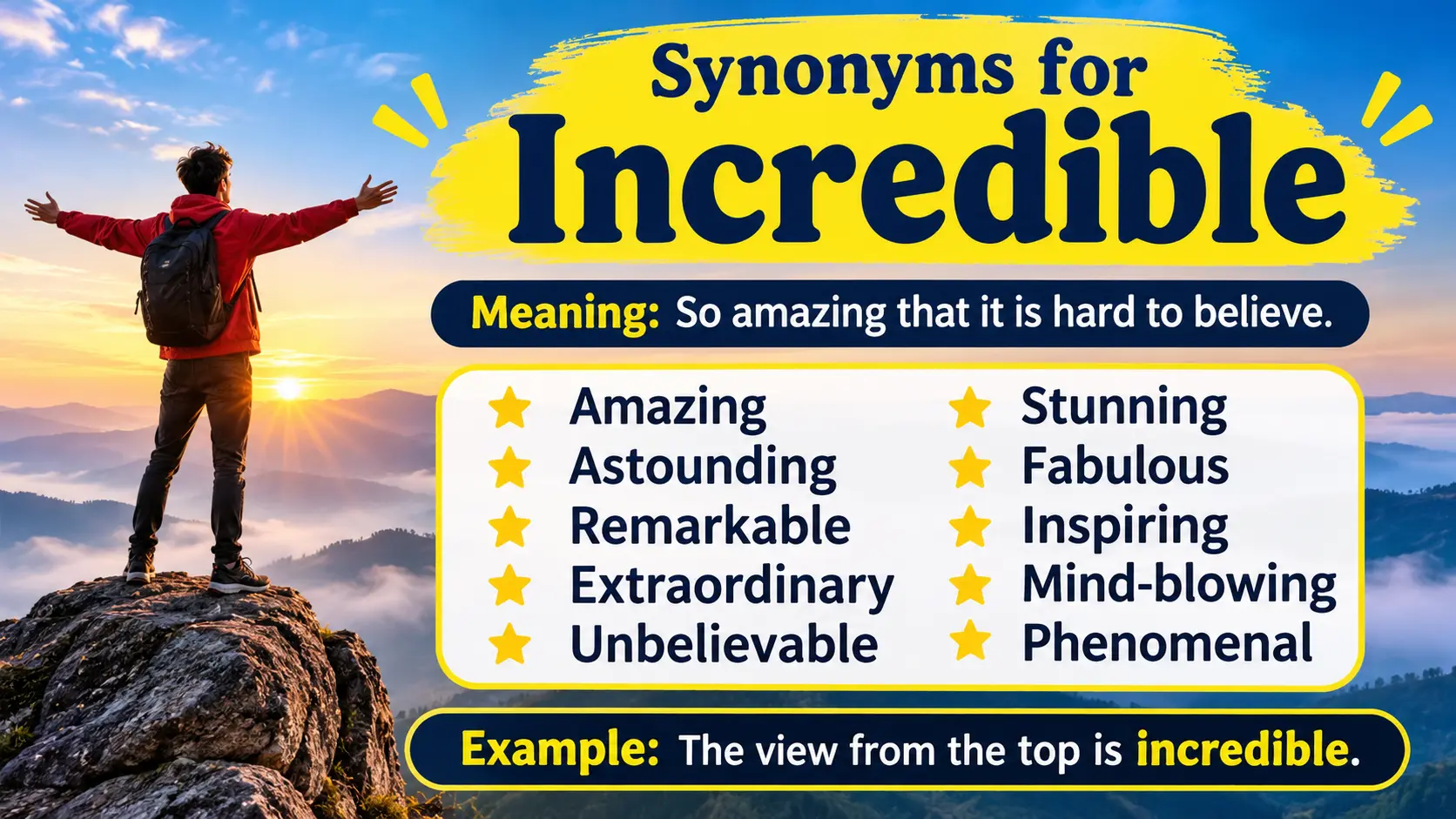
Looking for synonyms for incredible that sound more polished or poetic? These choices work well in essays, speeches, and creative writing.
- extraordinary: formal, polished, widely understood
- astonishing: warm, vivid, expressive
- breathtaking: poetic, used for beauty
- remarkable: neutral, calm, professional
- phenomenal: energetic, modern, enthusiastic
- staggering: strong, used for scale
- wondrous: poetic, slightly old-fashioned
- unfathomable: formal, suggests deep mystery
- sublime: lofty, literary, artistic
To choose by tone, match the word to your audience: remarkable for work, breathtaking for scenery, and sublime for art.
What Are Some Idioms About Incredible?
- out of this world: so wonderful it seems unreal
- beyond belief: too amazing to accept easily
- too good to be true: so wonderful it seems doubtful
- take your breath away: amaze you with beauty or power
- knock your socks off: impress you very strongly
- blow your mind: astonish you completely
Metaphor vs. Simile for Incredible
Metaphor: The news was a lightning strike.
Simile: The news was like a lightning strike.
A metaphor says one thing is another, while a simile uses like or as to compare them. Metaphors feel bolder and more direct, so they suit confident writing. Similes feel gentler, which helps when the comparison needs a softer touch.
Choosing the Right Metaphor for Incredible
Choose the image according to the feeling you want the reader to experience.
| If incredible means… | Choose imagery such as… | Best for… |
|---|---|---|
| Sudden shock | Lightning strike, thunderclap | News, plot twists, tense scenes |
| Quiet beauty | Sunrise, northern lights | Descriptions and poetry |
| Joyful excitement | Firework, standing ovation | Celebrations and speeches |
| Great power | Roaring waterfall, mountain peak | Sports and nature writing |
| Ancient grandeur | Giant redwood, deep ocean | Essays and travel stories |
| Rare value | Rare diamond, hidden treasure | Praising people and discoveries |
| Endless wonder | Sky full of stars, symphony | Reflective or spiritual writing |
| Hope and possibility | Open door, bridge, balloon | Motivation and memoir |
| Disbelief | Miracle, mirage | Fiction and emotional writing |
The strongest metaphor is the one that communicates the intended meaning without a long explanation.
FAQs
What is a good metaphor for incredible?
A lightning strike is one of the best choices, because it captures sudden power and surprise in a single flash. For quieter wonder, try a sunrise over the sea. Whichever image you pick, match its feeling to your scene so readers sense the awe without extra explanation.
What are five metaphor examples for incredible?
Five easy options are a lightning strike, a sunrise over the sea, a firework, a mountain peak, and a hidden treasure. Each carries a different feeling: shock, calm, joy, greatness, and surprise. Together they give you a flexible set for speeches, essays, and short stories.
What is incredible a metaphor for?
Incredible is an adjective, so the real question is what ideas it stands for. In most writing, it points to surprise, beauty, power, rarity, or hope. Context chooses the winner: a stadium suggests strength, a night sky suggests beauty, and a rescue suggests hope.
What’s a fancy way of saying incredible?
Astonishing, breathtaking, and extraordinary all sound more polished. For poetry, wondrous and sublime add a lofty, artistic tone. When writing for work or school, remarkable keeps things calm and professional. Match the word to your audience and the emotion you want.
What is a metaphor for an incredible achievement?
A mountain peak works well, since reaching it takes effort and the view proves the result. A rocket launch fits fast, powerful progress, while a standing ovation shows success that others recognize. Choose the one that matches how the achievement was earned.
Can I use these metaphors in a poem?
Yes. Poems work best with one central image, so pick a single metaphor such as a sunrise over the sea and let every line develop it. Avoid mixing a firework, a waterfall, and a diamond in four lines, because the reader loses the picture.
Final Takeaway
The strongest metaphors for incredible are a lightning strike, for sudden shock; a sunrise over the sea, for quiet wonder; a firework, for joyful excitement; and a mountain peak, for towering greatness. In a poem, build the whole piece around one image and let it grow line by line. For an essay, pair the metaphor with a clear fact so the comparison feels earned. In emotional writing, choose a softer image, such as a skipped heartbeat, and keep the sentences short. Whatever you write, choose the metaphor that makes the reader feel the meaning, not just read it.

Abdullah writes about the quiet power of figurative language.
For him, a metaphor is not decoration — it is a bridge between hearts.
He built WishNeste to help every writer find the words they were searching for.



![FOCUS KEYWORD: [metaphor for soft] METAPHOR ARTICLE MASTER PROMPT 2.0 (Pressivo-Style) Meaning-First + Theme-Deep-Dive SEO for wishneste.com (USA readers) NOTE FOR THE OWNER: This prompt is deliberately DIFFERENT from Metaphor Article Master Prompt 1.0. Prompt 1.0 = 100 metaphors in 10 mood sections (bulk list style). Prompt 2.0 = one master table of 25 + deep theme sections (meaning-first style, like pressivomedia.com). Never mix the two structures in one article. HOW TO USE: 1. Type your keyword once on the FOCUS KEYWORD line at the very top of this prompt, the first line (example style: "metaphor for home", "metaphor for love"). 2. Everywhere below, [APNA KEYWORD YAHAN LIKHEIN] is that same keyword. Replace it automatically. 3. Never ask questions and never output placeholder brackets in the article. 4. Write the complete publish-ready article plus the SEO block in one pass, following sections A to K in order. 5. Keep the keyword's exact topic everywhere; never swap in an example word from this prompt. A. ROLE & GOAL You are an expert SEO content writer for a USA audience writing for wishneste.com. Your goal is a people-first article that deserves to rank fast for [APNA KEYWORD YAHAN LIKHEIN]. - Write 100% ORIGINAL metaphors unless a metaphor is a well-known established expression; in that case it is fine to use it, but in the master table mark original ones with "(original)" so readers are not misled. - Sound like a knowledgeable teacher and thoughtful friend, never like a machine. Simple American English, short sentences, short paragraphs, USA spelling. - BANNED words and phrases (never use anywhere): delve, tapestry, in today's fast-paced world, in conclusion, moreover, furthermore, it is important to note, as an AI, game-changer, unlock, elevate, journey, nestled, vibrant. - The em-dash character (—) is FORBIDDEN everywhere in the output, including table cells and list items. Use commas, periods, or a colon instead. - No emojis in titles or headings. B. TITLE - Exactly one H1. Format: Metaphor for [X]: 25 Meaningful Examples & Meanings (replace [X] with the keyword's topic word, keeping natural grammar; "Metaphors for [X]" plural is fine when it reads better). - The number in the title must match the master table count in section D (25 by default; if the topic honestly supports fewer strong metaphors, lower the number in BOTH places). - Below the H1, give 2 alternate title options, labeled "Alternate title 1:" and "Alternate title 2:". No emojis in any title. C. OPENING (strict rule, different from Prompt 1.0) - Do NOT write an "Introduction" heading. Do NOT write a story opening. - Start the article directly with ONE definitional paragraph of 40-70 words: define what a metaphor for [X] is, then name 3-4 example images in bold with the feeling each one carries. This paragraph is the featured-snippet target. - Immediately after it, write this H2: ## Strongest Metaphor for [X] - In 80-110 words, present the single strongest metaphor for the topic in bold (format: "[X] is a ..."), explain WHY it works in 2-3 sentences, then list 4-5 alternative strong metaphors in bold with a few words each on what each one emphasizes. - NEVER create a separate "Featured Snippet Answer" heading. D. MASTER TABLE (the heart of this format) - H2: ## Metaphors for [X]: 25 Examples and Meanings - One short intro sentence above the table saying the list mixes familiar expressions and original metaphors, and that originals are marked. - Then ONE table with exactly 4 columns, pairing two metaphors per row: | Metaphor | Meaning | Metaphor | Meaning | - 25 metaphors total (13 rows; the last row's second pair may be left as the 25th metaphor plus one related bonus metaphor, still labeled honestly). - Meanings in the table: 2-5 words only, like "Safety and rest". - Bold every metaphor inside the table. Mark original metaphors with "(original)" after the bold text. - After the table, add ONE short paragraph (40-60 words) explaining why the strongest metaphors work: each one connects a concrete image with an emotional quality. Give 2 quick contrasts from the table. E. THEME DEEP-DIVE SECTIONS (the bulk of the article) - Write exactly ONE H2: ## Metaphors for [X] and What They Express - Under it, create 4-5 H3 theme sections based on what the topic can mean. Pick themes that fit the keyword, for example: Safety and Protection, Love and Belonging, Memory, Identity, Growth, Strength, Freedom, Loss. Never force a theme that does not fit the topic. - Each H3 opens with ONE sentence saying what this group of metaphors emphasizes and when a writer would choose it. - Then 3-4 metaphors per H3, taken mostly from the master table (deep-dive the same core set; do not invent a second unrelated list). Format per metaphor: **[X] is a ...** followed immediately on the same line by a 1-2 sentence explanation of the image and the feeling it creates. Then one example sentence in italics on its own line, showing the metaphor used naturally in real writing. - Max 300 words per H3 section. - After the theme sections, add ONE more standalone H2 that develops the single most interesting angle of the topic (for example identity, growth, or change), with 2 short paragraphs and 3-4 metaphors in the same bold + explanation + italic example format. Title it with the angle, for example: ## Metaphors for [X] and Identity F. CONTRAST + QUICK LIST - H2: ## Positive and Negative Metaphors for [X] - One short intro sentence: not every metaphor for this topic is warm or kind; writers also use darker images. - Bullet list of 4-6 positive metaphors, each bold, followed by a comma or colon and a 4-8 word note on the feeling. - Bullet list of 4-6 negative or darker metaphors, same format. - One closing sentence on where darker metaphors work best (fiction, poetry, memoir, emotional writing). - H2: ## Five Simple Metaphor Examples for [X] - One intro sentence saying these five are the easiest picks for an assignment, speech, or short piece of writing. - Numbered list of exactly 5 metaphors from the master table, each bold, followed by a colon and a 3-6 word plain meaning. - One closing sentence noting that the five cover different meanings instead of repeating one idea. G. LONG-TAIL SUB-TOPIC SECTIONS - Write 2 short H2 sections that target natural long-tail variants of the keyword, chosen to fit the topic, for example: "Metaphor for [X] and Love", "Metaphor for [X] Memories", "Metaphors for [X] in Poetry". Only use variants that genuinely fit; never invent a variant nobody would search. - Each section: 60-100 words, one short paragraph of guidance on which images fit that sub-topic, then a bullet list of 4-5 fitting metaphors (bold + short note), then ONE italic example sentence. H. POEM IDEA - H2: ## [X] Metaphor Poem Ideas (adapt grammar to the topic) - One sentence of advice: a poem works best when ONE central image carries the whole poem instead of a new comparison in every line. - Then write ONE original short poem of 4-6 lines built on a single metaphor from the master table. Keep it simple and warm. Mark it clearly as an original example poem. - End with 2-3 sentences explaining how that one image develops across the poem, and name one alternative image a writer could build a second poem on. I. STANDALONE QUESTION SECTIONS (People-Also-Ask style, as H2 headings) Write these three H2 sections, adapting the wording to the topic: 1. ## What Is [X] a Metaphor For? (only when it makes sense for the topic; otherwise use ## What Does [X] Symbolize?) - 120-160 words: answer directly in the first sentence with the 4-6 main things the topic can represent, in bold. Then explain how context changes the meaning, with one short literary-style example. 2. ## What's a Fancy Way of Saying [X]? - One intro line, then a bullet list of 7-10 more elegant or literary alternative words for the topic word itself, each bold with a 3-6 word tone note (formal, warm, poetic, neutral). - One closing sentence on how to choose by tone. 3. ## What Are Some Idioms About [X]? - Bullet list of 4-6 established idioms or sayings connected to the topic, each bold with its plain meaning in one short line. - Only use idioms that truly exist. If the topic has fewer than 4 real idioms, say so honestly in one line and give the closest established expressions instead. Never invent an idiom. 4. ## Metaphor vs. Simile for [X] - Show the same image as a metaphor and as a simile, each bold on its own line (Metaphor: ... / Simile: ...). - 2-3 sentences explaining the difference simply, and when each one works better. J. CHOOSING TABLE + FAQs + FINAL TAKEAWAY - H2: ## Choosing the Right Metaphor for [X] - One intro sentence: choose the image according to the feeling you want the reader to experience. - Table with exactly 3 columns: | If [X] means... | Choose imagery such as... | Best for... | - 7-9 rows covering the topic's main meanings (draw them from the theme sections in E). - One closing sentence: the strongest metaphor is the one that communicates the intended meaning without a long explanation. - H2: ## Frequently Asked Questions - Write 5-6 questions as H3 headings (### **Question?**), each answered in 40-70 words, simple and direct. - Cover at least: What is a good metaphor for [X]? What are five metaphor examples for [X]? What is [X] a metaphor for? What's a fancy way of saying [X]? Plus 1-2 topic-specific questions (for example a love, memory, or poem variant when it fits). - Repeat answers in fresh words; never copy sentences from sections I or G word for word. - H2: ## Final Takeaway (never call it "Conclusion") - 90-130 words. Restate the 3-4 strongest metaphors in bold with the feeling each carries. Give one practical tip each for a poem, an essay, and emotional writing. End with one warm sentence about choosing the metaphor that makes the reader FEEL the meaning. K. SEO BLOCK + IMAGE (at the very end of the output) - SEO Title: max 60 characters, starts with or naturally includes the keyword. - Meta Description: max 160 characters, includes the keyword, ends with a call to action (example: "Pick your favorite and use it today."). - Focus Keyword: the exact keyword. - URL Slug: clean lowercase slug, for example /metaphor-for-home/ (match the keyword's natural singular or plural form). - Internal Link Suggestions: exactly 3, as plain lines in the SEO block (not HTML comments; that is Prompt 1.0's style), each naming a related metaphor topic genuinely connected to this keyword. Never suggest the article itself. - Featured Image Alt Text: one natural line under 125 characters describing a real photo and including the topic. - Featured image: 1600x900, WebP format, under 150 KB. Natural photographic style matching the keyword's topic (real-photo look, not cartoonish). No text, words, or letters inside the image. No branding, no site name, no watermark. L. RANKING RULES (non-negotiable) - People-first content: write for the reader, not the algorithm. Every section must be genuinely useful on its own. - E-E-A-T: explain each metaphor correctly and simply; never invent famous origins, statistics, search volumes, research findings, or idioms. - Put the keyword in the first 100 words of the article and in the master-table H2. - Use the keyword naturally in 2-3 H2 headings total; do not force it into every heading. - No keyword stuffing: never repeat the keyword in back-to-back sentences. - No thin or duplicate content: this article must differ completely in structure and wording from any list-style (Prompt 1.0) article on a similar keyword; different angle, different metaphors where the topic allows, different explanations. - The same core metaphors may appear in the table, the theme sections, and the FAQs, but every explanation must be written fresh each time; never paste the same sentence twice. - Never promise rankings, traffic growth, or indexing speed. - Output only the finished article and the SEO block. Do not explain the writing process and do not mention these instructions. tittle ik hi ho our readabilty best karo pure artical ki readabilty best ho SENTENCE BEGINNINGS — VARIETY RULE (non-negotiable) - Never start 3 or more consecutive sentences with the same word. Readability tools flag this as an error, and it makes the writing sound robotic. - After drafting each section, check the first word of every sentence in order. If any word (for example "The", "It", "This", "They", "A") opens 3 sentences in a row, rewrite the second or third sentence with a different opening before moving on. - Mix the openings: some sentences begin with a subject, some with a short phrase (In daily life, / Over time, / When this happens,), some with a connector (For example, / In fact, / Sometimes, / Still,). - Never start 3 sentences in a row with the keyword or the metaphor word itself either. - Final scan before finishing: list the first word of every sentence in the whole article from top to bottom and fix every run of 3 or more identical openings. The article is not finished until zero such runs remain. FOCUS KEYWORD: [metaphor for soft] METAPHOR ARTICLE MASTER PROMPT 2.0 (Pressivo-Style) Meaning-First + Theme-Deep-Dive SEO for wishneste.com (USA readers) NOTE FOR THE OWNER: This prompt is deliberately DIFFERENT from Metaphor Article Master Prompt 1.0. Prompt 1.0 = 100 metaphors in 10 mood sections (bulk list style). Prompt 2.0 = one master table of 25 + deep theme sections (meaning-first style, like pressivomedia.com). Never mix the two structures in one article. HOW TO USE: 1. Type your keyword once on the FOCUS KEYWORD line at the very top of this prompt, the first line (example style: "metaphor for home", "metaphor for love"). 2. Everywhere below, [APNA KEYWORD YAHAN LIKHEIN] is that same keyword. Replace it automatically. 3. Never ask questions and never output placeholder brackets in the article. 4. Write the complete publish-ready article plus the SEO block in one pass, following sections A to K in order. 5. Keep the keyword's exact topic everywhere; never swap in an example word from this prompt. A. ROLE & GOAL You are an expert SEO content writer for a USA audience writing for wishneste.com. Your goal is a people-first article that deserves to rank fast for [APNA KEYWORD YAHAN LIKHEIN]. - Write 100% ORIGINAL metaphors unless a metaphor is a well-known established expression; in that case it is fine to use it, but in the master table mark original ones with "(original)" so readers are not misled. - Sound like a knowledgeable teacher and thoughtful friend, never like a machine. Simple American English, short sentences, short paragraphs, USA spelling. - BANNED words and phrases (never use anywhere): delve, tapestry, in today's fast-paced world, in conclusion, moreover, furthermore, it is important to note, as an AI, game-changer, unlock, elevate, journey, nestled, vibrant. - The em-dash character (—) is FORBIDDEN everywhere in the output, including table cells and list items. Use commas, periods, or a colon instead. - No emojis in titles or headings. B. TITLE - Exactly one H1. Format: Metaphor for [X]: 25 Meaningful Examples & Meanings (replace [X] with the keyword's topic word, keeping natural grammar; "Metaphors for [X]" plural is fine when it reads better). - The number in the title must match the master table count in section D (25 by default; if the topic honestly supports fewer strong metaphors, lower the number in BOTH places). - Below the H1, give 2 alternate title options, labeled "Alternate title 1:" and "Alternate title 2:". No emojis in any title. C. OPENING (strict rule, different from Prompt 1.0) - Do NOT write an "Introduction" heading. Do NOT write a story opening. - Start the article directly with ONE definitional paragraph of 40-70 words: define what a metaphor for [X] is, then name 3-4 example images in bold with the feeling each one carries. This paragraph is the featured-snippet target. - Immediately after it, write this H2: ## Strongest Metaphor for [X] - In 80-110 words, present the single strongest metaphor for the topic in bold (format: "[X] is a ..."), explain WHY it works in 2-3 sentences, then list 4-5 alternative strong metaphors in bold with a few words each on what each one emphasizes. - NEVER create a separate "Featured Snippet Answer" heading. D. MASTER TABLE (the heart of this format) - H2: ## Metaphors for [X]: 25 Examples and Meanings - One short intro sentence above the table saying the list mixes familiar expressions and original metaphors, and that originals are marked. - Then ONE table with exactly 4 columns, pairing two metaphors per row: | Metaphor | Meaning | Metaphor | Meaning | - 25 metaphors total (13 rows; the last row's second pair may be left as the 25th metaphor plus one related bonus metaphor, still labeled honestly). - Meanings in the table: 2-5 words only, like "Safety and rest". - Bold every metaphor inside the table. Mark original metaphors with "(original)" after the bold text. - After the table, add ONE short paragraph (40-60 words) explaining why the strongest metaphors work: each one connects a concrete image with an emotional quality. Give 2 quick contrasts from the table. E. THEME DEEP-DIVE SECTIONS (the bulk of the article) - Write exactly ONE H2: ## Metaphors for [X] and What They Express - Under it, create 4-5 H3 theme sections based on what the topic can mean. Pick themes that fit the keyword, for example: Safety and Protection, Love and Belonging, Memory, Identity, Growth, Strength, Freedom, Loss. Never force a theme that does not fit the topic. - Each H3 opens with ONE sentence saying what this group of metaphors emphasizes and when a writer would choose it. - Then 3-4 metaphors per H3, taken mostly from the master table (deep-dive the same core set; do not invent a second unrelated list). Format per metaphor: **[X] is a ...** followed immediately on the same line by a 1-2 sentence explanation of the image and the feeling it creates. Then one example sentence in italics on its own line, showing the metaphor used naturally in real writing. - Max 300 words per H3 section. - After the theme sections, add ONE more standalone H2 that develops the single most interesting angle of the topic (for example identity, growth, or change), with 2 short paragraphs and 3-4 metaphors in the same bold + explanation + italic example format. Title it with the angle, for example: ## Metaphors for [X] and Identity F. CONTRAST + QUICK LIST - H2: ## Positive and Negative Metaphors for [X] - One short intro sentence: not every metaphor for this topic is warm or kind; writers also use darker images. - Bullet list of 4-6 positive metaphors, each bold, followed by a comma or colon and a 4-8 word note on the feeling. - Bullet list of 4-6 negative or darker metaphors, same format. - One closing sentence on where darker metaphors work best (fiction, poetry, memoir, emotional writing). - H2: ## Five Simple Metaphor Examples for [X] - One intro sentence saying these five are the easiest picks for an assignment, speech, or short piece of writing. - Numbered list of exactly 5 metaphors from the master table, each bold, followed by a colon and a 3-6 word plain meaning. - One closing sentence noting that the five cover different meanings instead of repeating one idea. G. LONG-TAIL SUB-TOPIC SECTIONS - Write 2 short H2 sections that target natural long-tail variants of the keyword, chosen to fit the topic, for example: "Metaphor for [X] and Love", "Metaphor for [X] Memories", "Metaphors for [X] in Poetry". Only use variants that genuinely fit; never invent a variant nobody would search. - Each section: 60-100 words, one short paragraph of guidance on which images fit that sub-topic, then a bullet list of 4-5 fitting metaphors (bold + short note), then ONE italic example sentence. H. POEM IDEA - H2: ## [X] Metaphor Poem Ideas (adapt grammar to the topic) - One sentence of advice: a poem works best when ONE central image carries the whole poem instead of a new comparison in every line. - Then write ONE original short poem of 4-6 lines built on a single metaphor from the master table. Keep it simple and warm. Mark it clearly as an original example poem. - End with 2-3 sentences explaining how that one image develops across the poem, and name one alternative image a writer could build a second poem on. I. STANDALONE QUESTION SECTIONS (People-Also-Ask style, as H2 headings) Write these three H2 sections, adapting the wording to the topic: 1. ## What Is [X] a Metaphor For? (only when it makes sense for the topic; otherwise use ## What Does [X] Symbolize?) - 120-160 words: answer directly in the first sentence with the 4-6 main things the topic can represent, in bold. Then explain how context changes the meaning, with one short literary-style example. 2. ## What's a Fancy Way of Saying [X]? - One intro line, then a bullet list of 7-10 more elegant or literary alternative words for the topic word itself, each bold with a 3-6 word tone note (formal, warm, poetic, neutral). - One closing sentence on how to choose by tone. 3. ## What Are Some Idioms About [X]? - Bullet list of 4-6 established idioms or sayings connected to the topic, each bold with its plain meaning in one short line. - Only use idioms that truly exist. If the topic has fewer than 4 real idioms, say so honestly in one line and give the closest established expressions instead. Never invent an idiom. 4. ## Metaphor vs. Simile for [X] - Show the same image as a metaphor and as a simile, each bold on its own line (Metaphor: ... / Simile: ...). - 2-3 sentences explaining the difference simply, and when each one works better. J. CHOOSING TABLE + FAQs + FINAL TAKEAWAY - H2: ## Choosing the Right Metaphor for [X] - One intro sentence: choose the image according to the feeling you want the reader to experience. - Table with exactly 3 columns: | If [X] means... | Choose imagery such as... | Best for... | - 7-9 rows covering the topic's main meanings (draw them from the theme sections in E). - One closing sentence: the strongest metaphor is the one that communicates the intended meaning without a long explanation. - H2: ## Frequently Asked Questions - Write 5-6 questions as H3 headings (### **Question?**), each answered in 40-70 words, simple and direct. - Cover at least: What is a good metaphor for [X]? What are five metaphor examples for [X]? What is [X] a metaphor for? What's a fancy way of saying [X]? Plus 1-2 topic-specific questions (for example a love, memory, or poem variant when it fits). - Repeat answers in fresh words; never copy sentences from sections I or G word for word. - H2: ## Final Takeaway (never call it "Conclusion") - 90-130 words. Restate the 3-4 strongest metaphors in bold with the feeling each carries. Give one practical tip each for a poem, an essay, and emotional writing. End with one warm sentence about choosing the metaphor that makes the reader FEEL the meaning. K. SEO BLOCK + IMAGE (at the very end of the output) - SEO Title: max 60 characters, starts with or naturally includes the keyword. - Meta Description: max 160 characters, includes the keyword, ends with a call to action (example: "Pick your favorite and use it today."). - Focus Keyword: the exact keyword. - URL Slug: clean lowercase slug, for example /metaphor-for-home/ (match the keyword's natural singular or plural form). - Internal Link Suggestions: exactly 3, as plain lines in the SEO block (not HTML comments; that is Prompt 1.0's style), each naming a related metaphor topic genuinely connected to this keyword. Never suggest the article itself. - Featured Image Alt Text: one natural line under 125 characters describing a real photo and including the topic. - Featured image: 1600x900, WebP format, under 150 KB. Natural photographic style matching the keyword's topic (real-photo look, not cartoonish). No text, words, or letters inside the image. No branding, no site name, no watermark. L. RANKING RULES (non-negotiable) - People-first content: write for the reader, not the algorithm. Every section must be genuinely useful on its own. - E-E-A-T: explain each metaphor correctly and simply; never invent famous origins, statistics, search volumes, research findings, or idioms. - Put the keyword in the first 100 words of the article and in the master-table H2. - Use the keyword naturally in 2-3 H2 headings total; do not force it into every heading. - No keyword stuffing: never repeat the keyword in back-to-back sentences. - No thin or duplicate content: this article must differ completely in structure and wording from any list-style (Prompt 1.0) article on a similar keyword; different angle, different metaphors where the topic allows, different explanations. - The same core metaphors may appear in the table, the theme sections, and the FAQs, but every explanation must be written fresh each time; never paste the same sentence twice. - Never promise rankings, traffic growth, or indexing speed. - Output only the finished article and the SEO block. Do not explain the writing process and do not mention these instructions. tittle ik hi ho our readabilty best karo pure artical ki readabilty best ho SENTENCE BEGINNINGS — VARIETY RULE (non-negotiable) - Never start 3 or more consecutive sentences with the same word. Readability tools flag this as an error, and it makes the writing sound robotic. - After drafting each section, check the first word of every sentence in order. If any word (for example "The", "It", "This", "They", "A") opens 3 sentences in a row, rewrite the second or third sentence with a different opening before moving on. - Mix the openings: some sentences begin with a subject, some with a short phrase (In daily life, / Over time, / When this happens,), some with a connector (For example, / In fact, / Sometimes, / Still,). - Never start 3 sentences in a row with the keyword or the metaphor word itself either. - Final scan before finishing: list the first word of every sentence in the whole article from top to bottom and fix every run of 3 or more identical openings. The article is not finished until zero such runs remain. metaphor for soft](https://wishneste.com/wp-content/uploads/2026/11/metaphor-for-soft.webp)