
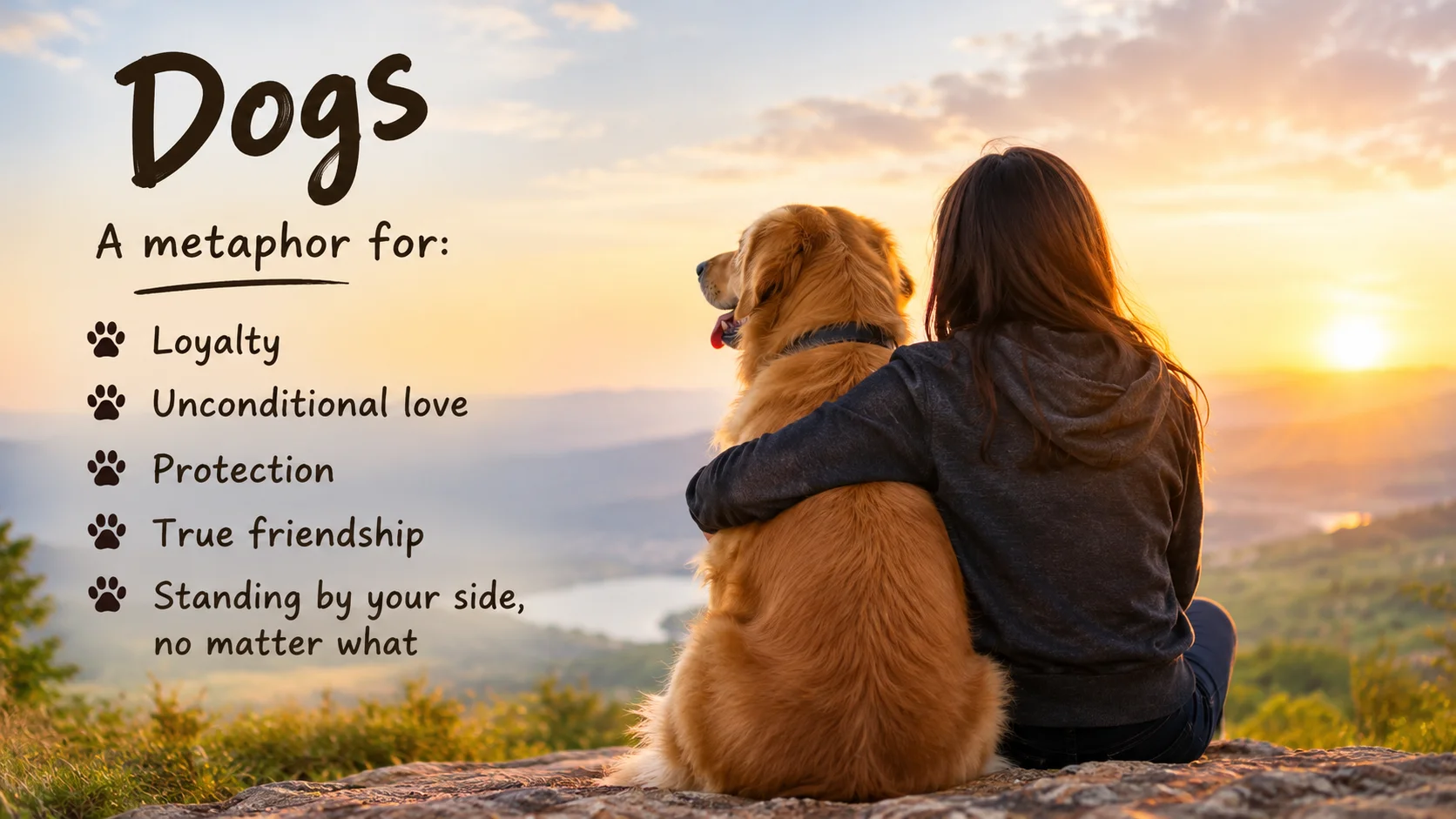
A metaphor for dogs describes a dog by calling it something else, so one image carries a whole feeling. Think of a living sunbeam for joy, a loyal shadow for devotion, a four-legged alarm for protection, or a furry therapist for comfort. Each comparison turns everyday companionship into a picture readers can see and feel.
Strongest Metaphor for Dogs
A dog is a heart with four legs. Love is usually invisible, but this image gives it a body that runs to the door, wags, and leans against your knee. Readers feel the warmth right away because the feeling becomes something they can picture. That is why it opens so many dog tributes. Other strong choices include a loyal shadow (constant devotion), a living sunbeam (instant warmth), a four-legged alarm (watchful protection), a furry therapist (quiet comfort), and a wagging flag (open happiness).
Metaphors for Dogs: 25 Examples and Meanings
This list mixes familiar expressions with original metaphors, and the original ones are marked so you always know which is which.
| Metaphor | Meaning | Metaphor | Meaning |
|---|---|---|---|
| Man’s best friend | Loyal companionship | A heart with four legs (original) | Love with a body |
| A loyal shadow (original) | Constant devotion | A living sunbeam (original) | Instant warmth |
| A four-legged alarm (original) | Watchful protection | A furry therapist (original) | Quiet comfort |
| A wagging flag (original) | Open happiness | A walking hug (original) | Warm affection |
| A mirror with a tail (original) | Reflects your mood | A bundle of joy | Pure delight |
| A furry alarm clock (original) | Morning energy | A soft anchor (original) | Steady calm |
| A lighthouse in fur (original) | Guidance toward home | A forgiving teacher (original) | Fresh starts daily |
| A fuzzy tornado (original) | Playful chaos | A warm blanket with a pulse (original) | Cozy comfort |
| A silent promise (original) | Unspoken loyalty | The family’s heartbeat (original) | Center of home |
| A mop of mischief (original) | Naughty charm | A watchdog | Alert guardian |
| Top dog | Leader or winner | A gray-muzzled elder (original) | Wisdom and age |
| A paw-printed memory (original) | Lasting remembrance | A co-pilot with a tail (original) | Adventure partner |
| A tail-wagging welcome (original) | Greeting at home | A sleeping furnace (bonus, original) | Warm, peaceful rest |
The strongest metaphors work because each one ties a concrete image to an emotional quality. A living sunbeam is bright and brief, so it suggests joy that arrives fast. By contrast, a soft anchor is heavy and still, so it suggests calm that holds you in place.
Metaphors for Dogs and What They Express
Loyalty and Devotion
These metaphors stress a dog’s steady presence, and writers choose them for tributes, memoirs, and stories about faithfulness.
A dog is a loyal shadow. It follows every step without being asked and stays close even on the hardest days. This image suits writing about constant, quiet devotion.
Wherever I walked that winter, my dog walked a half step behind me, a loyal shadow with a warm nose.
A dog is a silent promise. Nothing needs to be said, because the dog’s staying says everything. Readers sense a bond that rests on trust instead of words.
He never spoke a word of comfort, yet his whole life was a silent promise that I would not be alone.
A dog is man’s best friend. Familiar as it is, this phrase still works because it names friendship without conditions or scorekeeping. For a plain, honest tribute, it is hard to beat.
Years later, I still trust that old phrase, because my dog proved it every evening at the door.
Comfort and Healing
Calm is the focus here, and these images fit moments of grief, stress, or loneliness.
A dog is a furry therapist. Without judging or interrupting, a dog listens to everything and somehow knows when you need company. The image adds gentle humor to a serious kind of care.
After the long shift, she rested her chin on my knee, a furry therapist who never sent a bill.
A dog is a walking hug. Warmth travels from room to room on four paws. Readers picture affection that never stays in one spot.
Whenever the house felt too quiet, a walking hug padded in and curled up at my feet.
A dog is a warm blanket with a pulse. Coziness meets life here, so comfort seems to breathe and answer back. It works well for cold nights and long recoveries.
On winter evenings, the old collie was a warm blanket with a pulse draped across my feet.
A dog is a soft anchor. When thoughts drift and worries swirl, a dog’s calm weight holds you in place. Steadiness is the feeling this image gives.
Worry kept pulling at me, but he was a soft anchor, heavy and calm against my side.
Joy and Playfulness
Here the mood is bright, and writers pick these images for children’s stories, captions, and happy memories.
A dog is a living sunbeam. The room gets warmer the moment this dog arrives. Happiness shows up without a reason and needs no invitation.
She burst through the door, a living sunbeam that erased the gray afternoon.
A dog is a wagging flag. Like a flag on a windy day, the tail announces the mood from far away. Joy becomes visible to everyone nearby.
He crossed the park as a wagging flag, telling everyone that I had finally arrived.
A dog is a fuzzy tornado. Puppy energy spins through the house with chaos and delight. Nothing stays where you left it.
Our new puppy was a fuzzy tornado, and by noon the living room had never looked so alive.
A dog is a mop of mischief. Stolen socks, chewed slippers, and a guilty look all fit this picture. Forgiveness arrives within seconds.
Behind the couch hid a mop of mischief, holding one very stolen sock.
Protection and Guardianship
Strength and watchfulness come first in this group, so it suits adventure, mystery, and family stories.
A dog is a four-legged alarm. Long before a knock sounds, the ears lift and the bark begins. Readers see protection that never takes a day off.
Before the doorbell even rang, our four-legged alarm was on his feet and facing the door.
A dog is a watchdog. This familiar word carries steady attention and a strong sense of duty. It is the simplest way to show a dog standing guard.
Every night, the old shepherd patrolled the yard, a watchdog who took his job seriously.
A dog is a night-shift guard. While everyone sleeps, this dog keeps one ear open. The image adds quiet pride to the idea of protection.
All through the storm, the night-shift guard lay across the hallway with his eyes half open.
Home and Belonging
These images show how a dog turns a house into a home, which makes them useful for family stories and memoir.
A dog is the family’s heartbeat. Daily life seems to move around feeding times, walks, and naps. Take the dog away, and the rhythm of the house changes.
Our whole routine kept time with the family’s heartbeat, who needed breakfast at six sharp.
A dog is a tail-wagging welcome. Coming home feels different when someone greets you with total joy. This image captures belonging in a single moment.
No matter how the day went, a tail-wagging welcome met me at the door.
A dog is a lighthouse in fur. Familiar and steady, the dog marks the way back to safety and love. Readers sense direction and comfort at once.
However late I came back, the lighthouse in fur was waiting by the window.
Metaphors for Dogs and Time
Dogs live beside us through whole seasons of life, so writers often use them to mark time. A puppy marks a beginning, while a gray muzzle marks the long middle and the gentle end.
Because dog years pass quickly, these metaphors often carry a touch of ache. Use them when you want readers to feel gratitude and loss together.
A dog is a gray-muzzled elder. The silver around the mouth tells a story of years, patience, and quiet wisdom. It suits gentle writing about aging.
Now a gray-muzzled elder, he climbs the stairs slowly but still meets me at the door.
A dog is a paw-printed memory. Even after a dog is gone, small marks remain in photos, in habits, and in the heart. This image suits remembrance and healing.
Years later, the house still held a paw-printed memory in every corner.
A dog is a clock that runs too fast. Dog years pass quickly, and this image captures the ache of that truth. Gratitude and sadness sit side by side in it.
He was a clock that ran too fast, and we spent every hour trying to enjoy him.
Positive and Negative Metaphors for Dogs
Not every metaphor for dogs is warm or kind, and writers sometimes reach for darker images.
Positive metaphors
- A living sunbeam: brings instant, uncomplicated happiness
- A loyal shadow: stays close in every season
- A furry therapist: listens and calms without words
- A heart with four legs: love given a moving body
- A soft anchor: steady comfort in rough moments
Negative or darker metaphors
- A rain-soaked stray: loneliness and being left behind
- A dog on a short chain: loyalty trapped by control
- A growling storm: threat building before it breaks
- A hungry shadow: need that never feels satisfied
- A barking alarm that never stops: stress and constant noise
Darker metaphors work best in fiction, poetry, memoir, and other emotional writing, where readers expect some shadow.
Five Simple Metaphor Examples for Dogs
These five are the easiest picks for an assignment, a speech, or a short piece of writing.
- A living sunbeam: sudden, bright happiness
- A loyal shadow: always right beside you
- A walking hug: warm, moving affection
- A four-legged alarm: always ready to protect
- A paw-printed memory: love that stays behind
Together, the five cover different meanings instead of repeating one idea.
Metaphor for Dogs and Love
Dog love is easy to feel and hard to explain, so choose images that show it in action. Look for pictures with motion, warmth, or closeness, because these match how dogs really show affection.
- A heart with four legs: love that runs to you
- A walking hug: affection on the move
- A wagging flag: love announced loudly
- A tail-wagging welcome: love waiting at the door
Every evening, my heart with four legs was already at the door, and her tail told me I was loved.
Metaphors for a Dog’s Loyalty
Loyalty in dogs is about staying, so the best images suggest closeness, patience, and trust. Choose shadows, promises, and anchors when you want readers to feel faithfulness over time.
- A loyal shadow: always one step behind
- A silent promise: faithfulness without a word
- A soft anchor: holds steady through storms
- Man’s best friend: the classic, trusted phrase
Through every move and every hard year, he stayed a silent promise at my side.
Dog Metaphor Poem Ideas
A poem works best when one central image carries the whole poem instead of a new comparison in every line. Here is an original example poem built on a single metaphor.
My dog is a shadow that learned to love. He follows my steps from room to room. When I stand, he rises. When I rest, he stays. No sunlight is needed to keep him near. Even in the dark, he is still beside me.
Notice how the shadow image grows. It begins with simple following, then moves to staying, and finally shows loyalty that needs no light at all. A writer could build a second poem on a living sunbeam, letting the same single image carry a whole poem about joy.
What Is a Dog a Metaphor For?
A dog is most often a metaphor for loyalty, unconditional love, protection, companionship, joy, and comfort. Context decides which meaning rises to the surface. In a war story, a dog by a soldier’s side stands for faithfulness and courage. In a child’s story, a puppy usually stands for joy and new beginnings. A stray at the edge of a poem can stand for loneliness or hope, depending on how the writer treats it. Even the same wagging tail can show happiness in one scene and trust in another. Look at what surrounds the dog, and the meaning becomes clear. For example, a dog waiting by a quiet window suggests patience and love, while a dog pacing at a locked gate suggests worry or the urge to protect.
What’s a Fancy Way of Saying Dog?
If the plain word feels too ordinary, these alternatives add tone and variety.
- Canine: neutral and slightly formal
- Hound: poetic, old-fashioned feel
- Companion animal: formal and respectful
- Four-footed friend: warm and literary
- Faithful companion: warm and sentimental
- Pooch: playful and casual
- Pup: affectionate, often for young dogs
- Mutt: casual and fond, mixed breed
- Best friend: warm and personal
Pick formal words for reports, poetic ones for verse, and playful ones for friendly, casual writing.
What Are Some Idioms About Dogs?
- Let sleeping dogs lie: Do not stir up old trouble.
- Every dog has its day: Everyone gets a turn at success.
- Raining cats and dogs: Raining very hard.
- Dog tired: Completely worn out.
- Barking up the wrong tree: Chasing the wrong idea or person.
- You can’t teach an old dog new tricks: Older people resist new habits.
Metaphor vs. Simile for Dogs
Metaphor: My dog is a living sunbeam.
Simile: My dog is like a living sunbeam.
A metaphor says one thing is another, while a simile says one thing is like another. Metaphors feel bolder and more direct, so they suit poems and strong emotional moments. Similes feel gentler and clearer, which helps in simple essays or when you want readers to see the comparison step by step.
Choosing the Right Metaphor for Dogs
Choose the image according to the feeling you want your reader to experience.
| If a dog means… | Choose imagery such as… | Best for… |
|---|---|---|
| Loyalty | A loyal shadow, a silent promise, man’s best friend | Tributes and essays |
| Comfort | A furry therapist, a walking hug, a warm blanket with a pulse | Emotional writing and cards |
| Joy | A living sunbeam, a wagging flag, a bundle of joy | Captions and children’s stories |
| Protection | A four-legged alarm, a watchdog, a night-shift guard | Fiction and speeches |
| Home | The family’s heartbeat, a tail-wagging welcome, a soft anchor | Memoir and family stories |
| Playful chaos | A fuzzy tornado, a mop of mischief | Humor and blog posts |
| Old age and wisdom | A gray-muzzled elder, a paw-printed memory | Poems and remembrance |
| Adventure | A co-pilot with a tail, a lighthouse in fur | Travel writing and stories |
The strongest metaphor is the one that communicates your meaning without a long explanation.
FAQs
What is a good metaphor for dogs?
A good pick is a heart with four legs, because it turns love into a creature that runs, wags, and comforts. If you want something simpler, a loyal shadow shows devotion in just a few words. Choose the image whose feeling matches your point, whether that is joy, comfort, or protection.
What are five metaphor examples for dogs?
Five easy choices are a living sunbeam, a loyal shadow, a walking hug, a four-legged alarm, and a paw-printed memory. Together they cover joy, loyalty, affection, protection, and remembrance. That variety helps when you need examples for a class assignment or a short speech.
What is a dog a metaphor for?
Writers use dogs to stand for loyalty, love without conditions, and steady companionship. Depending on the story, a dog can also mean protection, innocence, or loneliness. The surrounding scene shapes the meaning, so a dog at a grave reads very differently from a dog in a sunny yard.
What’s a fancy way of saying dog?
Try canine for formal writing, hound for a poetic touch, or faithful companion for a warm, sentimental tone. Casual options like pooch and pup suit friendly posts. Tone is your guide, so match the word to the mood of the sentence.
What is a good metaphor for a dog’s loyalty?
A loyal shadow is the clearest choice, since a shadow never leaves your side. For a quieter feeling, try a silent promise, which suggests faithfulness without words. Both images work well in tributes and memoir passages.
How do I write a metaphor about my own dog?
Start with one real habit, such as how your dog greets you or sleeps beside you. Then ask what that habit feels like and name it with a concrete image. A dog that meets you after work might become a tail-wagging welcome. Keep it short and true to what you see.
Final Takeaway
The best metaphors for dogs make a feeling visible. A heart with four legs carries love, a loyal shadow carries devotion, a living sunbeam carries joy, and a soft anchor carries calm. For a poem, build everything around one central image and let it grow line by line. In an essay, choose a metaphor that supports your main point and explain it in a sentence or two. For emotional writing, keep the image simple and true to something you have actually seen your dog do. Whatever you choose, pick the metaphor that makes your reader feel the meaning, not just understand it.

Abdullah writes about the quiet power of figurative language.
For him, a metaphor is not decoration — it is a bridge between hearts.
He built WishNeste to help every writer find the words they were searching for.