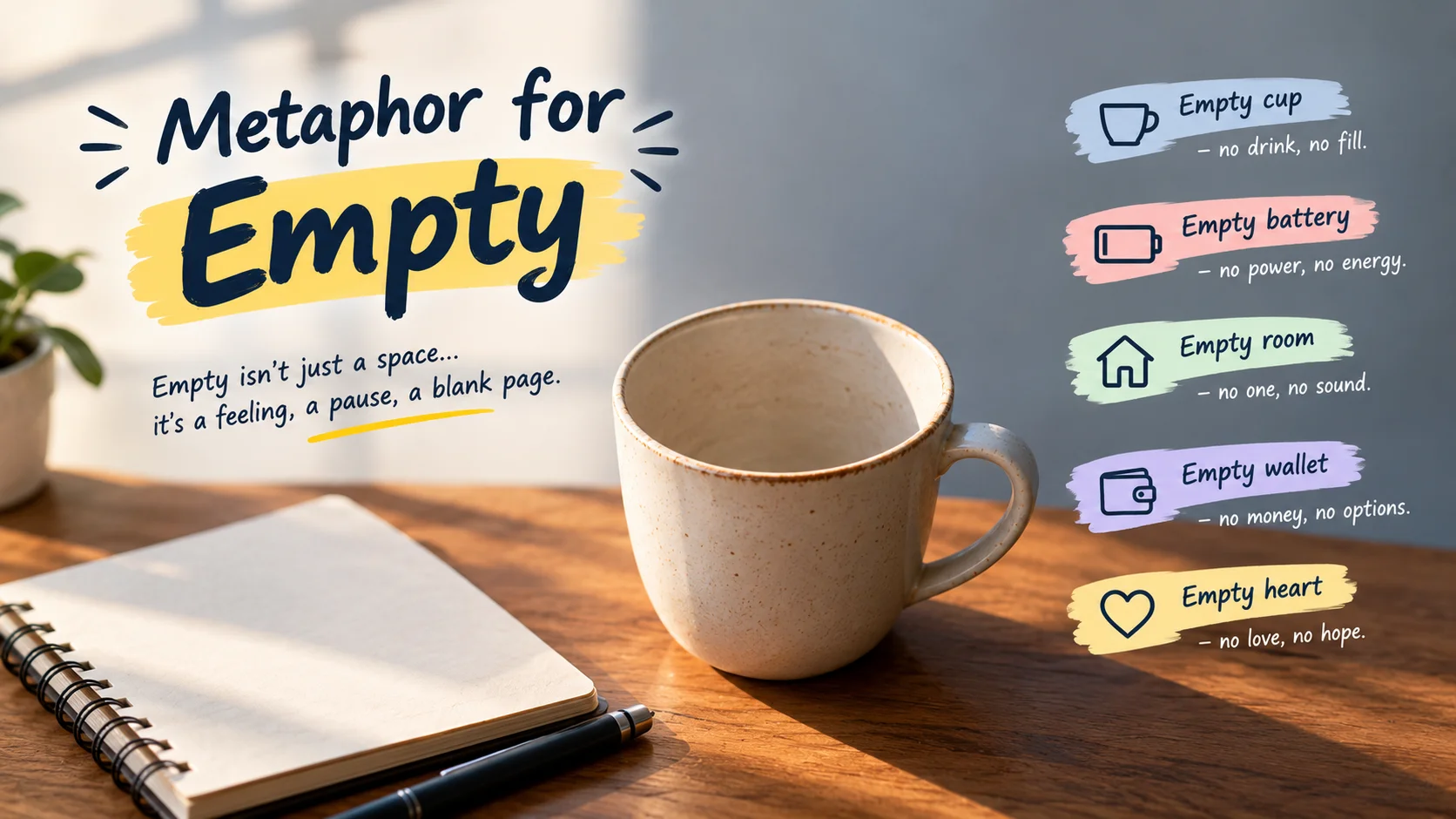
Alternate title 1: Metaphor for Empty: 25 Powerful Images and What They Mean
Alternate title 2: 25 Metaphors for Empty to Describe Hollow, Lonely Feelings
A metaphor for empty describes a lack of life, meaning, or contents by comparing it to something concrete. Common images include a hollow shell, which suggests lost purpose; a dry well, which suggests exhaustion; a ghost town, which suggests loneliness; and a blank page, which suggests open possibility.
Strongest Metaphor for Empty
Empty is a dry well. A well exists to give water, so when it runs dry, the loss is about purpose as well as supply. Readers instantly feel the thirst, the effort of lowering the bucket, and the silence that comes back. Other strong choices include a hollow shell (lost inner life), a ghost town (loneliness after people leave), a blank page (empty but full of potential), a black hole (emptiness that pulls everything in), and a coat with no one inside (the absence of a person).
Metaphors for Empty: 25 Examples and Meanings
This list mixes familiar expressions with fresh images, and original metaphors are marked with (original).
| Metaphor | Meaning | Metaphor | Meaning |
|---|---|---|---|
| A hollow shell | Lost inner substance | A dry well | Nothing left to give |
| A barren desert | Lifeless, lonely space | A blank page | Fresh start, open future |
| A bottomless pit | Needs that never fill | A ghost town | Abandoned and forgotten |
| A black hole | Drains everything nearby | A void | Total absence of meaning |
| An unfilled vessel | Waiting to be filled | A dead battery | Energy fully gone |
| An abandoned nest | Home after children leave | A coat with no one inside (original) | Absence of someone loved |
| A playground at midnight (original) | Silence after laughter ends | A stage after the last show (original) | Applause gone, quiet remains |
| A school hallway in July (original) | Life paused, nobody there | A song with the sound off (original) | A voice no one hears |
| A lighthouse with no lamp (original) | Purpose gone, light off | A beach after the tide leaves (original) | What remains after loss |
| A mailbox with no mail (original) | Waiting for connection | A cabinet with one cup (original) | Loneliness in small details |
| A house with the lights off (original) | Home without warmth | A winter orchard (original) | Rest before new growth |
| A closet with bare hangers (original) | Missing pieces of life | A train platform at 3 a.m. (original) | Waiting with nobody around |
| A bowl scraped clean (original) | Nothing left after giving | A cleared desk (bonus, related) | Calm, open possibility |
The strongest metaphors work because each one connects a concrete image with an emotional quality. A dry well feels like exhaustion, while a blank page feels like possibility. Likewise, a ghost town carries loneliness, but a winter orchard carries patience. Choose the image that matches the feeling.
Metaphors for Empty and What They Express
Loneliness and Abandonment
These metaphors stress that empty can mean nobody is around, so choose them for scenes of isolation and neglect.
Empty is a ghost town. Buildings still stand, yet no one walks the streets. The image suits places and feelings that once held people.
After the layoffs, the office became a ghost town by 6 p.m.
Empty is a playground at midnight. Swings hang still where laughter should be, and the silence feels sharper because the place was built for noise.
Without his sister, the apartment turned into a playground at midnight.
Empty is a train platform at 3 a.m. Everyone has gone home, and only waiting remains. This image captures lonely time that moves slowly.
Her evenings had become a train platform at 3 a.m., quiet and endless.
Empty is a school hallway in July. Lockers stay shut and every footstep echoes, which shows how loud absence can be.
Since the move, our group chat has been a school hallway in July.
Exhaustion and Burnout
Use these when empty describes a tired body or mind that has nothing left to give.
Empty is a dry well. People keep lowering the bucket, but only dust comes back up. The image fits anyone who has given until nothing remained.
By December, Marcus was a dry well, still showing up with nothing to offer.
Empty is a dead battery. A device can look normal and still refuse to turn on. This metaphor gives sudden exhaustion a practical, modern tone.
Even after eight hours of sleep, Jana was a dead battery by noon.
Empty is a bowl scraped clean. Nothing is wasted and nothing remains. That image shows someone who gave every last bit of energy to a task, often with quiet pride.
Once the final report went out, Priya was a bowl scraped clean.
Empty is a barren desert. Water, shade, and growth are all missing, so the picture suggests a long dry stretch with no relief. Writers use it when tiredness lasts for months.
Months of night shifts turned his motivation into a barren desert.
Loss and Grief
Pick these metaphors when empty points to a missing person, a quiet home, or a life that has changed shape.
Empty is a coat with no one inside. The shape remains, but the warmth is gone. It shows how absence can feel almost physical.
Grandpa’s jacket still hung by the door, a coat with no one inside.
Empty is an abandoned nest. Twigs and feathers remain after the birds have flown. This image fits parents, and anyone else, who feel a home growing quiet.
When the twins left for college, the house became an abandoned nest.
Empty is a house with the lights off. Every window stays dark, which makes the home feel cold from the street. It shows the loss of warmth more than the loss of furniture.
Following the divorce, her place was a house with the lights off.
Empty is a cabinet with one cup. Small details can hurt most, and a single cup says that a pair has become one. The image works well in quiet, personal writing.
Every morning, Elena faced a cabinet with one cup.
Meaning and Purpose
Choose these metaphors when empty describes a life, job, or belief that has lost its point.
Empty is a hollow shell. A shell keeps its shape, but the living part is gone. This image suits people who look fine outside and feel lost inside.
Behind the polite smile, Hector was a hollow shell.
Empty is a bottomless pit. Nothing seems to fill it, no matter how much goes in. The picture shows a craving or sadness that never ends.
For years, his hunger for approval was a bottomless pit.
Empty is a black hole. Light and energy vanish into it, so the image feels heavy and dramatic. Writers use it for emptiness that drains the people nearby.
Their silence became a black hole, and every conversation vanished into it.
Empty is a lighthouse with no lamp. The tower stands tall, yet it cannot guide anyone. It shows a person or job that has lost its guiding purpose.
Without a goal, her career became a lighthouse with no lamp.
Possibility and Fresh Starts
Not every empty is sad, so these metaphors treat it as space, rest, or a chance to begin.
Empty is a blank page. Nothing is written yet, so anything can happen. The image carries nerves and hope together.
In a new city, Jo finally had a blank page.
Empty is a winter orchard. Bare branches look lifeless, yet roots keep working underground. This image shows rest before growth.
Between jobs, he was a winter orchard, quiet but not finished.
Empty is an unfilled vessel. A cup or jar waits for something worthwhile to pour in. It suggests openness and a willingness to learn.
Walking into class, she was an unfilled vessel, ready for new ideas.
Empty is a cleared desk. Papers are gone and the surface is ready for new work. The image turns emptiness into calm order.
On Monday morning, her mind was a cleared desk.
Metaphors for Empty and Identity
Some of the strongest writing about empty is really about the self. When a role ends, a voice goes quiet, or no one notices you, the feeling is less about a place and more about who you are. Metaphors help readers see that private feeling.
Because identity is invisible, writers borrow stages, songs, and open spaces to give it a shape. Each image below asks a quiet question: who am I when nothing is happening around me?
Empty is a stage after the last show. Lights are off and costumes are packed, so the performer faces a bare floor. The image fits anyone whose big role has ended.
Retirement left Ken on a stage after the last show.
Empty is a song with the sound off. The notes still exist, but no one can hear them. It shows a person who has a voice and cannot use it.
Throughout the meeting, Aisha was a song with the sound off.
Empty is a mailbox with no mail. Day after day, the door opens and nothing arrives. The image captures the feeling of being unseen or forgotten.
Each evening, Leo checked his phone, a mailbox with no mail.
Empty is a void. No edges give you anything to hold, so the word suits deep, formless feelings. Short and stark, it hits hard.
Late at night, the void asked questions she could not answer.
Positive and Negative Metaphors for Empty
Not every metaphor for this topic is warm or kind; writers also use darker images.
Positive metaphors:
- A blank page: open space for something new
- A winter orchard: rest before new growth
- An unfilled vessel: ready and willing to learn
- A cleared desk: calm order and fresh focus
- A beach after the tide leaves: peaceful space after change
Negative metaphors:
- A bottomless pit: hunger that never gets fed
- A black hole: draining everything around it
- A ghost town: abandoned and painfully quiet
- A hollow shell: looks fine but lacks life
- A closet with bare hangers: nothing left of a former life
Darker metaphors work best in fiction, poetry, memoir, and other emotional writing, where readers expect honesty about pain.
Five Simple Metaphor Examples for Empty
These five are the easiest picks for an assignment, speech, or short piece of writing.
- A hollow shell: lost inner life or purpose
- A dry well: nothing left to give
- A ghost town: abandoned and lonely
- A blank page: fresh start, open future
- A black hole: emptiness that swallows everything
Together, the five cover lost meaning, exhaustion, loneliness, hope, and endless draining, so no two repeat the same idea.
Metaphor for an Empty Heart
An empty heart usually means numbness, longing, or love that has nowhere to go. Pick images that show hunger or silence, not only darkness. One concrete object often says more than a long explanation.
- A cold fireplace: warmth that has gone out
- A locked room: feelings kept out of reach
- A cabinet with one cup: loneliness in small things
- A dry well: love with nothing left to give
- A song with the sound off: feeling that cannot be heard
Since the breakup, her heart was a cold fireplace in a quiet house.
Metaphors for an Empty House
A house is built for people, so an empty one makes absence easy to see and hear. Writers often focus on echoes, bare walls, and dust. Small details help the reader feel the quiet.
- A shell on the beach: shape without a living tenant
- A stage with the curtain down: a place waiting for people
- A closet with bare hangers: belongings gone, memories left
- A house with the lights off: no warmth at the window
- A museum after closing: rooms full of silence
Dust settled on the stairs, and the house became a museum after closing.
Empty Metaphor Poem Ideas
A poem works best when one central image carries the whole poem instead of a new comparison in every line.
Original example poem:
I am a well at the edge of town. The rope still swings, the bucket goes down. It finds no water, only a sound, A small, dry echo from the ground. Then clouds roll in and the first rain falls, And I hear the water against my walls.
The poem builds one image, a dry well, from the lowered bucket to the echo to the returning rain. Each detail adds to the feeling of waiting, so the last lines can offer hope without adding a new comparison. A writer could build a second poem on a house with the lights off, moving from dark windows to one light coming on.
What Does Empty Symbolize?
Empty can symbolize loneliness, loss, exhaustion, lost purpose, and new possibility. Context decides which meaning wins. An empty chair at a dinner table points to grief, while an empty calendar after a busy year may suggest relief. In fiction, an empty room often shows that something important has changed or someone has gone. Self-help writing often treats an empty cup as readiness to learn. Poetry may use an empty street for silence, fear, or peace. Readers pick up on small clues such as light, weather, and who is missing. Without them, the word alone stays flat. For that reason, add one detail that guides the feeling. For example: The empty chair at the head of the table said what no one dared to say.
What’s a Fancy Way of Saying Empty?
These words add polish, and each one carries a slightly different tone.
- Vacant: formal, used for rooms or seats
- Unoccupied: formal, not currently in use
- Desolate: poetic, lonely and bleak
- Barren: poetic, lifeless and bare
- Hollow: warm and poetic, something missing inside
- Devoid: formal, used with the word “of”
- Vacuous: formal, lacking ideas or thought
- Bare: neutral, simple and plain
- Deserted: neutral, left by all people
To choose by tone, use vacant or unoccupied for formal writing, desolate or barren for poetry, and bare or deserted for an everyday style.
What Are Some Idioms About Empty?
- Running on empty: having no energy or fuel left
- Empty-handed: carrying or getting nothing
- Empty nest: a home after the children move out
- Empty vessels make the most noise: people who know least often talk loudest
- An empty threat: a warning nobody plans to carry out
Metaphor vs. Simile for Empty
Metaphor: Empty is a dry well.
Simile: Empty is like a dry well.
A metaphor states that one thing is another, which makes the image feel direct and strong. A simile uses “like” or “as,” so it feels softer and more careful. Use a metaphor when you want impact, and a simile when you want the comparison to stay gentle.
Choosing the Right Metaphor for Empty
Choose the image according to the feeling you want the reader to experience.
| If empty means… | Choose imagery such as… | Best for… |
|---|---|---|
| Loneliness | A ghost town, a train platform at 3 a.m. | Fiction and personal essays |
| Exhaustion | A dry well, a dead battery | Burnout stories and blog posts |
| Grief | A coat with no one inside, a cabinet with one cup | Memoir and tribute writing |
| Lost purpose | A hollow shell, a lighthouse with no lamp | Character studies and speeches |
| Endless craving | A bottomless pit, a black hole | Poetry and dramatic scenes |
| A fresh start | A blank page, a cleared desk | Motivational writing and new-chapter posts |
| Rest before growth | A winter orchard | Reflective essays and captions |
| Feeling unseen | A mailbox with no mail, a song with the sound off | Short stories and social posts |
The strongest metaphor is the one that communicates the intended meaning without a long explanation.
Frequently Asked Questions
What is a good metaphor for empty?
A dry well is a strong choice. It shows a source that once gave freely and now has nothing left, so readers feel both the loss and the effort. If you want loneliness instead, try a ghost town. For hope, a blank page works better.
What are five metaphor examples for empty?
Five easy picks are a hollow shell, a dry well, a ghost town, a blank page, and a black hole. They cover lost purpose, exhaustion, loneliness, hope, and endless draining. Choose one that matches your topic, and add a short detail so readers can see the scene.
What is empty a metaphor for?
Empty can stand for loneliness, grief, burnout, lost meaning, or a fresh beginning. The surrounding scene tells readers which one you mean. A bare room after a funeral feels sad, but a bare room before a move feels hopeful.
What’s a fancy way of saying empty?
Vacant and unoccupied sound formal, while desolate and barren feel poetic. Hollow suggests something is missing inside, and devoid works well with the word “of,” as in “devoid of hope.” Match the word to your tone before you choose.
What is a good metaphor for an empty heart?
Try a cold fireplace, a locked room, or a dry well. Each shows a different side of the feeling: lost warmth, hidden emotion, or love with nothing left to give. Add a small object, such as one cup in a cabinet, to make it personal.
Can I use more than one metaphor in a poem?
You can, but one central image usually works better. Several comparisons in a short poem can blur the feeling. Build the poem around one picture, such as a dry well, and let each line add a new detail to it.
Final Takeaway
The best metaphors for empty turn an abstract feeling into a picture. A dry well carries exhaustion, a ghost town carries loneliness, a hollow shell carries lost purpose, and a blank page carries hope. For a poem, build everything around one image and let each line add a detail. In an essay, pick the metaphor that matches your main point, then explain it once in plain words. For emotional writing, use a small, concrete object, because tiny details feel real. Whatever you choose, pick the metaphor that makes your reader feel the meaning, not only understand it.

Abdullah writes about the quiet power of figurative language.
For him, a metaphor is not decoration — it is a bridge between hearts.
He built WishNeste to help every writer find the words they were searching for.