Alternate title 1: Metaphors for Funny: 25 Images That Capture Humor Alternate title 2: What Is a Metaphor for Funny? 25 Examples and Meanings
A metaphor for funny turns the feeling of humor into a picture instead of just saying something made us laugh. Writers reach for images like a tickle in the brain, a spark that catches, sunshine breaking through clouds, or a firework going off, each one carrying a slightly different flavor of surprise, warmth, or release.
Strongest Metaphor for Funny
Funny is a spark that catches before you can stop it. This image works because humor often arrives suddenly rather than building slowly, and it spreads from one person to another the way a spark jumps across dry grass. It also explains why laughter feels involuntary, quick, and shared rather than planned. Several other strong metaphors capture different sides of the same feeling. A tickle in the brain points to that sudden, almost physical jolt of delight. A firework going off emphasizes the short, bright burst of a joke landing well. A loose thread unraveling tension shows how humor releases pressure in a tight moment. A mirror held up sideways captures comedy’s habit of showing truth from an odd angle. A skip in a heartbeat focuses on the light jolt of surprise behind a good laugh.
Metaphors for Funny: 25 Examples and Meanings
The list below mixes familiar expressions with fresh, original images. Each original metaphor is marked so readers know which comparisons are established and which ones were built for this article.
| Metaphor | Meaning | Metaphor | Meaning |
|---|---|---|---|
| A tickle in the brain (original) | Sudden delight | A spark that catches (original) | Quick ignition of laughter |
| A firework going off | Short burst of joy | Sunshine breaking through clouds | Relief and warmth |
| A loose thread unraveling tension (original) | Releases stress | A mirror held up sideways (original) | Truth shown playfully |
| A skip in a heartbeat (original) | Light jolt of surprise | A rubber band snapping back (original) | Quick release of tension |
| A pressure valve letting off steam | Stress relief | A wink between strangers (original) | Shared understanding |
| A bubble rising to the surface (original) | Light, effortless joy | A trapdoor under seriousness (original) | Sudden shift, surprise |
| A court jester’s bell (original) | Playful disruption | A match struck in the dark (original) | Sudden spark of insight |
| A whoopee cushion under formality (original) | Deflating seriousness | A secret handshake (original) | Shared inside joke |
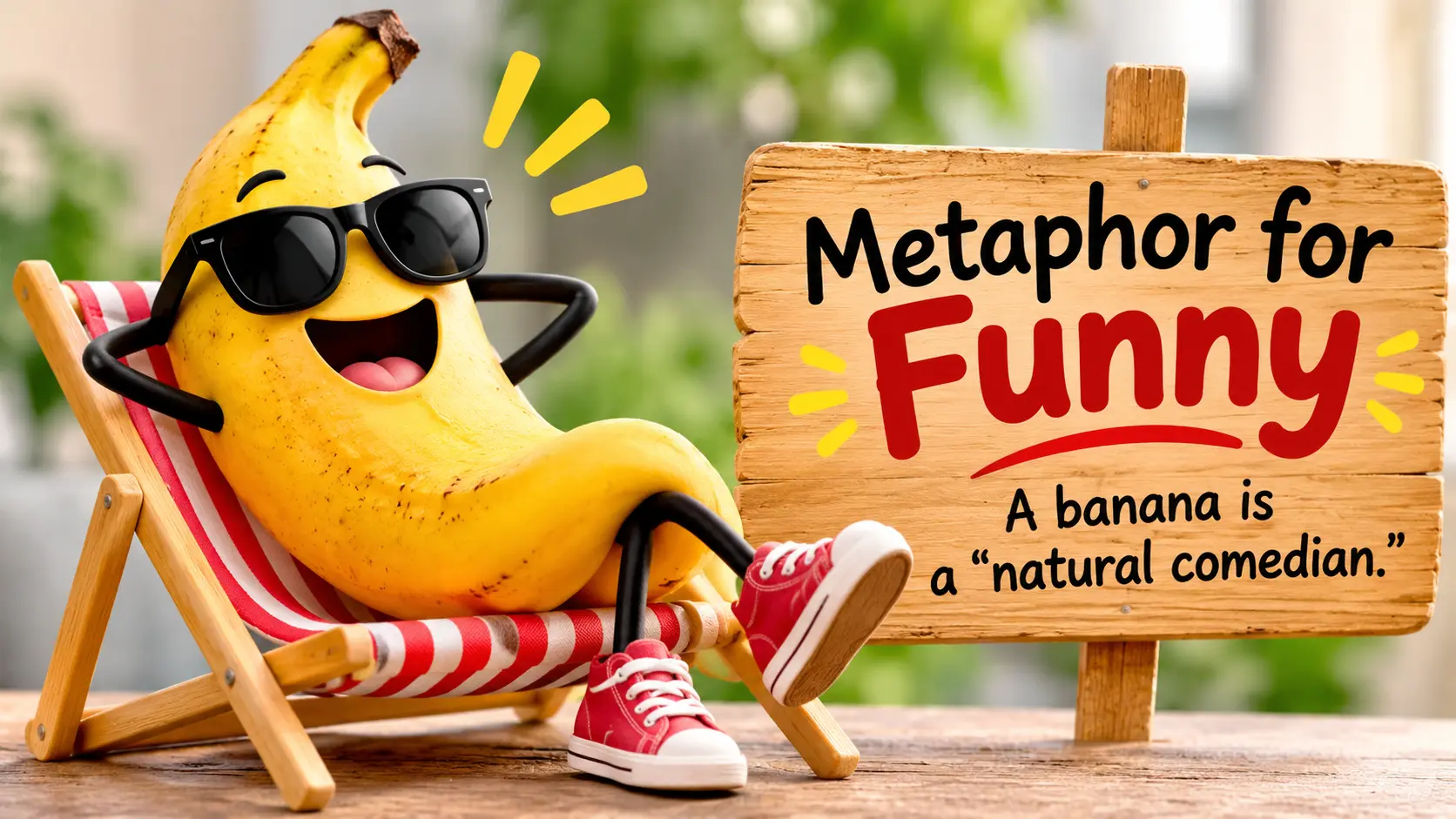
| A bright balloon in a gray room (original) | Lightness amid dullness | A banana peel on a serious path (original) | Comic disruption of order |
| A puzzle piece that doesn’t fit, on purpose (original) | Absurdity that delights | A cool breeze on a hot day | Relief, lightness |
| A domino of giggles (original) | Contagious laughter | A court of clowns in a palace of rules (original) | Humor defying seriousness |
| A pinch that makes you jump, gently (original) | Light startling delight | A kite catching wind unexpectedly (original) | Sudden lift, joy |
| A candle lighting another candle (original) | Laughter passed person to person | A ripple spreading across water (bonus, original) | Humor moving through a crowd |
Metaphors for Funny and What They Express
Humor shows up in more than one mood, so the right metaphor depends on what a writer wants the reader to feel.
Surprise and Spontaneity
This group fits moments when humor arrives out of nowhere and catches someone off guard, which makes it useful for scenes built around timing or punchlines.
Funny is a spark that catches. The image works because sparks ignite instantly, matching how a good joke lands before the brain has time to prepare for it. The comment landed like a spark that caught before anyone could react.
Funny is a trapdoor under seriousness. A trapdoor hides itself until the exact moment it opens, much like a joke slipped into a formal setting. His speech had a trapdoor under it, and the whole room fell through laughing.
Funny is a match struck in the dark. Striking a match creates a sudden point of light, close to how a sharp line of wit cuts through a dull moment. Her one-liner was a match struck in the dark of a silent meeting.
Relief and Release
These metaphors suit humor that eases tension rather than shocking the reader, which makes them a natural fit for scenes following stress or grief.
Funny is a pressure valve letting off steam. A valve exists to release built-up pressure safely, the same job humor often does during a hard week. After the funeral, one shared memory became a pressure valve for all of us.
Funny is a loose thread unraveling tension. Pulling a single thread can loosen an entire knot, similar to how one well-placed joke can soften a tense room. His joke was the loose thread that finally unraveled the tension at the table.
Funny is a cool breeze on a hot day. A breeze interrupts discomfort without removing the heat entirely, much like humor that lightens a hard moment without erasing it. Her laugh was a cool breeze on an otherwise exhausting afternoon.
Connection and Shared Laughter
This set works well when humor is less about the joke itself and more about the bond it creates between people.
Funny is a candle lighting another candle. One flame passing to the next mirrors how laughter spreads from person to person in a room. His grin lit mine like a candle lighting another candle.
Funny is a wink between strangers. A wink signals quiet understanding without a single word, similar to an inside joke shared instantly between two people. We hadn’t met before, but her joke felt like a wink between strangers.
Funny is a secret handshake. A handshake known only to a small group marks belonging, and shared humor often does the same thing. Our old nickname for him became a kind of secret handshake between us.
Lightness Amid Seriousness
These metaphors highlight humor’s habit of showing up where it feels least expected, cutting through heaviness without ignoring it.
Funny is a bright balloon in a gray room. A single balloon stands out sharply against dull surroundings, much like one light comment in a serious discussion. His offhand remark floated through the meeting like a bright balloon in a gray room.
Funny is a court jester’s bell. The jester’s bell announces itself playfully even inside a formal royal court, echoing how humor interrupts strict settings. She carried herself like a court jester’s bell, impossible to ignore in any serious room.
Funny is a whoopee cushion under formality. Hidden beneath something proper, it waits to undercut seriousness the moment someone sits down. The toast started formally, then turned into a whoopee cushion under all that formality.
Absurdity and Play
This group fits humor built on the unexpected or the slightly ridiculous, useful for scenes that lean into silliness rather than subtlety.
Funny is a banana peel on a serious path. A single slip can derail an otherwise orderly walk, similar to how one absurd detail can unravel a formal moment. The pun dropped like a banana peel on an otherwise serious presentation.
Funny is a puzzle piece that doesn’t fit, on purpose. Forcing the wrong piece into place creates a small, satisfying disruption, much like a joke built on mismatch. His answer was a puzzle piece that didn’t fit, on purpose, and the room loved it.
Funny is a court of clowns in a palace of rules. Placing playfulness inside a strict structure creates contrast that feels both silly and pointed. Their office felt like a court of clowns in a palace of rules.
Metaphors for Funny and Identity
Humor often becomes part of how people see themselves and how others remember them, which makes it a rich angle beyond simple jokes. Someone known for always lightening the mood carries that reputation the way a nickname sticks, shaping how a room expects them to behave before they even speak.
Several metaphors fit this identity angle well. Funny is a second language. Some people seem to think in jokes the way others think in numbers, switching into it naturally. He speaks funny the way other people speak French, fluently and without trying. Funny is a shield with a soft center. Many people use humor to protect themselves while still staying warm underneath. Her jokes were a shield with a soft center, guarding feelings she rarely showed directly. Funny is a signature on every room they enter. A distinct sense of humor can mark someone as clearly as handwriting. You could always tell he’d been there, his humor was a signature on every room he entered.
Positive and Negative Metaphors for Funny
Not every metaphor for humor stays warm or kind. Writers also reach for darker images when comedy turns sharp, cruel, or hollow.
Positive metaphors for funny:
- A firework going off: bright, sudden joy
- Sunshine breaking through clouds: warmth and relief
- A candle lighting another candle: laughter spreading gently
- A cool breeze on a hot day: easy, welcome relief
- A secret handshake: quiet belonging and connection
Negative metaphors for funny:
- A joke with a blade hidden inside: humor used to wound
- A laugh track playing over silence: forced, hollow amusement
- A grin stretched too tight: humor covering real discomfort
- A pie thrown too hard: comedy that tips into cruelty
- A clown mask over a tired face: laughter hiding exhaustion or pain
Darker metaphors like these tend to work best in fiction, poetry, memoir, or any writing exploring humor’s uncomfortable edges rather than its lighter side.
Five Simple Metaphor Examples for Funny
These five metaphors make easy picks for a quick assignment, a short speech, or a simple piece of writing.
- A spark that catches: quick, sudden laughter
- A firework going off: a short burst of joy
- A pressure valve letting off steam: stress relief through humor
- A wink between strangers: instant, shared understanding
- A candle lighting another candle: laughter passed along a room
Together, these five cover different meanings instead of repeating the same idea in slightly different words.
Metaphor for a Funny Person
Describing a funny person often calls for an image built around personality rather than a single joke. The right comparison should hint at warmth, timing, or energy without sounding forced.
- A walking spark: always ready to ignite a laugh
- A human punchline machine: quick, constant comic timing
- A sunbeam in a crowded room: instant warmth and lightness
- A built-in pressure valve: naturally eases tense situations
- A secret handshake waiting to happen: instantly creates inside jokes
My uncle has always been a walking spark, lighting up every family dinner within minutes.
Metaphors for Funny Moments in Everyday Life
Ordinary days hold plenty of small, funny moments that rarely get described with much imagery, even though a good metaphor can make them feel more vivid.
- A loose thread unraveling tension: a joke that breaks a stressful stretch
- A cool breeze on a hot day: a laugh that interrupts a dull routine
- A bright balloon in a gray room: one funny comment in a flat meeting
- A banana peel on a serious path: a small slip that derails seriousness
- A kite catching wind unexpectedly: sudden joy in an unplanned moment
The office had gone quiet for hours until his comment became a bright balloon in a gray room.
Funny Metaphor Poem Ideas
A strong poem usually works best when one central image carries the whole piece instead of switching comparisons in every line.
Original example poem:
A spark jumps first between your eyes and mine, too quick to name before it catches. It leaps the table, finds the next face, then the next, a small fire with no edges. By the time it reaches the back of the room, we are all just burning a little, together.
This poem builds around a single spark image, following it from the first spark of a joke through the way it spreads person to person until the whole room shares the same warmth. A writer looking for a second poem on the same topic could instead build around the candle image, following one flame lighting the next down a long table.
What Does Funny Symbolize?
Funny often symbolizes relief, connection, rebellion, intelligence, coping, and surprise, though which meaning stands out depends heavily on context. In a hospital waiting room, a shared joke usually points toward relief and coping, easing fear without denying it. At a dinner party, the same kind of joke might lean more toward connection, pulling strangers into a shared moment. In satire or political writing, funny often leans toward rebellion, using laughter to challenge authority without open confrontation. A quick wordplay pun, meanwhile, tends to highlight intelligence, showing off quick thinking rather than emotional release. Literature often plays with these shifts deliberately. In many tragicomedies, a single joke dropped into a heavy scene can symbolize both relief and rebellion at once, giving characters a way to survive hardship without pretending it isn’t there.
What’s a Fancy Way of Saying Funny?
Several elegant alternatives exist for writers who want to avoid repeating the word “funny” too often.
- Witty: sharp, formal
- Hilarious: energetic, casual
- Droll: dry, understated
- Comical: light, playful
- Whimsical: fanciful, poetic
- Mirthful: warm, old-fashioned
- Jocular: formal, lighthearted
- Amusing: neutral, versatile
- Farcical: exaggerated, theatrical
- Riotous: loud, energetic
Choosing between these comes down to tone. A formal essay might reach for witty or jocular, while a casual blog post fits better with hilarious or amusing.
What Are Some Idioms About Funny?
A handful of established idioms connect directly to the idea of being funny.
- In stitches: laughing uncontrollably
- Tickled pink: very amused or delighted
- Crack someone up: make someone laugh hard
- The funny bone: a person’s sense of humor
- Laugh your head off: laugh extremely hard
- A barrel of laughs: a very funny person or situation
Metaphor vs. Simile for Funny
Metaphor: Funny is a spark that catches before you can stop it. Simile: Funny is like a spark that catches before you can stop it.
The metaphor states the comparison directly, treating humor as if it actually were a spark, which creates a stronger, more immediate image. The simile softens that same comparison with “like,” making it feel slightly more explanatory and better suited to writing that wants to guide the reader gently rather than surprise them.
Choosing the Right Metaphor for Funny
Picking the right image comes down to the exact feeling a writer wants the reader to experience, not just the fact that something is funny.
| If Funny means… | Choose imagery such as… | Best for… |
|---|---|---|
| Sudden surprise | A spark, a match struck in the dark | Punchlines, comedic timing |
| Relief from tension | A pressure valve, a cool breeze | Scenes after stress or grief |
| Shared connection | A wink, a secret handshake | Friendship, inside jokes |
| Contrast with seriousness | A bright balloon, a whoopee cushion | Formal settings, satire |
| Playful absurdity | A banana peel, a puzzle piece that doesn’t fit | Silly or exaggerated humor |
| Personality or identity | A walking spark, a shield with a soft center | Character descriptions |
| Coping through hardship | A candle in a dark room, a trapdoor under grief | Memoir, emotional writing |
| Contagious energy | A domino of giggles, a ripple across water | Group scenes, crowd reactions |
The strongest metaphor is simply the one that communicates its meaning clearly, without needing a long explanation to make sense.
FAQs
What is a good metaphor for funny?
A strong option is calling something funny “a spark that catches,” since it captures how humor often arrives suddenly and spreads quickly between people. This image works well because sparks are fast, bright, and hard to control once they start.
What are five metaphor examples for funny?
Five solid choices include a spark that catches, a firework going off, a pressure valve letting off steam, a wink between strangers, and a candle lighting another candle. Each one highlights a different side of humor, from surprise to shared connection.
What is funny a metaphor for?
Funny often stands in for relief, connection, rebellion, intelligence, or coping, depending on the situation. A joke during a hard moment usually points toward relief, while playful wordplay often signals quick thinking instead.
What’s a fancy way of saying funny?
Writers looking for alternatives often choose witty, droll, hilarious, mirthful, or jocular, depending on how formal or playful the piece needs to sound. Witty and jocular fit more formal writing, while hilarious feels casual and energetic.
What’s a good metaphor for a funny person?
Describing someone as “a walking spark” or “a human punchline machine” captures a personality built around constant comic timing. These images suggest energy and readiness rather than a single isolated joke.
How do I use a metaphor for funny in a poem?
The strongest approach is choosing one image, such as a spark or a candle, and following it through the entire poem instead of switching comparisons line by line. Letting a single picture grow and shift keeps the poem focused and easier to feel.
Final Takeaway
A few metaphors for funny stand out above the rest. A spark that catches captures humor’s sudden, uncontrollable energy. A pressure valve letting off steam shows how laughter eases tension after hard moments. A candle lighting another candle reflects how humor spreads from person to person in a shared space. Build a poem around one of these images instead of switching between several. When writing an essay, use the metaphor to open a paragraph and revisit it near the end to connect the main idea. For emotional writing, choose darker or gentler images because humor can carry more meaning than it first appears to.Choose whichever metaphor makes the reader feel the laugh, not just read about it.

Abdullah writes about the quiet power of figurative language.
For him, a metaphor is not decoration — it is a bridge between hearts.
He built WishNeste to help every writer find the words they were searching for.