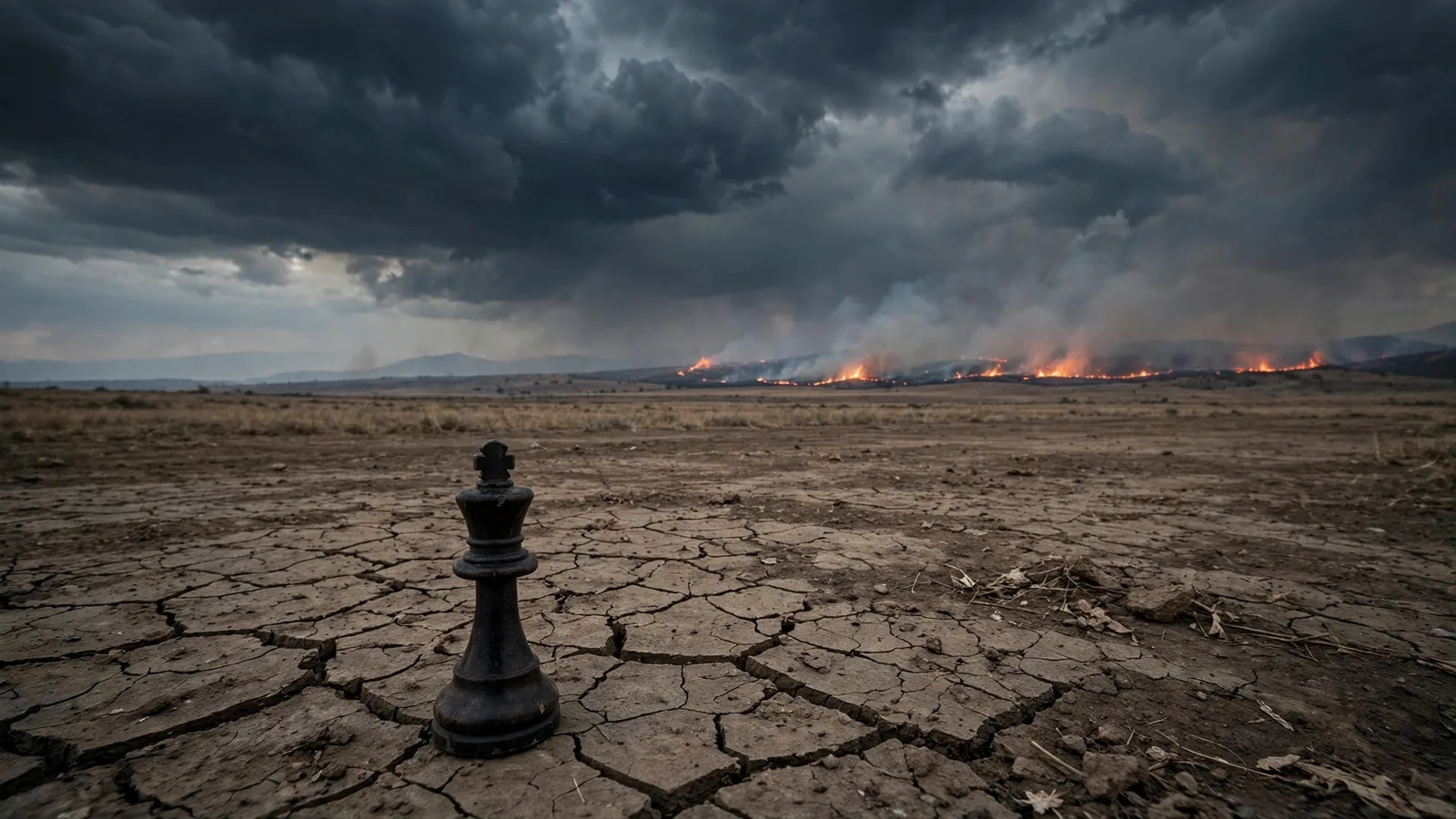
A metaphor for war describes conflict by calling it something else, such as a wildfire that spreads and destroys, a storm that brings chaos, a thief that steals years and people, or a chess game where lives become pieces. Each image helps readers feel what war means beyond facts and numbers.
Strongest Metaphor for War
War is a wildfire. It starts small, feeds on whatever stands near it, and leaves ash where homes and futures used to be. The image works because fire is easy to picture, hard to control, and impossible to undo. Readers feel both the speed and the loss in one picture. Other strong choices include war is a thief (what it steals), war is a storm (chaos and fear), war is a chess game (people used as pieces), war is a long winter (cold waiting and hardship), and war is a debt (a cost paid later).
Metaphors for War: 25 Examples and Meanings
This list mixes familiar expressions with fresh images, and the original metaphors are marked.
| Metaphor | Meaning | Metaphor | Meaning |
|---|---|---|---|
| War is a wildfire | Spreads and destroys | War is a storm | Chaos and upheaval |
| War is a beast | Hunger that devours | War is a chess game | Strategy using people |
| War is a thief | Steals years and lives | War is a disease | Spreads suffering |
| War is a row of dominoes | One fall, many follow | War is a forge | Pain that shapes |
| War is a bottomless pit (original) | Endless loss | War is a gambling table (original) | Lives as stakes |
| War is a grinding machine (original) | Cold, crushing process | War is a long winter (original) | Cold, slow hardship |
| War is a scar on the land (original) | Lasting visible damage | War is a furnace (original) | Burns away softness |
| War is a debt (original) | Paid by later generations | War is a tide (original) | Pulls everyone in |
| War is a broken clock (original) | Time stops | War is a shadow (original) | Fear that follows |
| War is a mirror (original) | Shows human nature | War is a stage (original) | Powerful act, others suffer |
| War is a flood (original) | Overwhelms and washes away | War is a knot (original) | Hard to untie |
| War is a closed door (original) | Futures shut off | War is a harvest of grief (original) | Sorrow reaped |
| War is a letter never delivered (original) | Grief still waiting | War is a silent house (original, bonus) | Emptiness after the noise |
The strongest metaphors connect a concrete image with an emotional quality. War is a thief makes loss personal, while war is a chess game feels cold and calculated. War is a wildfire shows speed and destruction, but war is a long winter shows slow, grinding hardship. Pick the image that matches the feeling you want.
Metaphors for War and What They Express
Destruction and Chaos
These metaphors stress speed, force, and damage, and they suit writing about the moment war breaks out or tears a place apart.
War is a wildfire. It races across fields and towns, feeding on whatever it touches. The reader feels how fast ordinary life can vanish.
By spring, war was a wildfire, and no village in the valley could outrun it.
War is a storm. It arrives with warning signs, then shakes everything loose. This image carries fear and helplessness.
War was a storm that tore the roofs off every house on our street.
War is a flood. It rises quietly, fills every low place, and carries away what people thought was solid. It works well for slow, overwhelming change.
The flood of war covered the fields, then the roads, then the last of our hope.
War is a furnace. The heat is so strong that it burns away softness and leaves only what can survive. It suits stories about intensity and hardening.
Inside the furnace of war, kindness became something rare and hard to keep.
Loss and Grief
Choose these when the writing is about what war takes from people, one life or one memory at a time.
War is a thief. It steals fathers, sons, sleep, and years, and it never gives anything back. The image makes loss feel personal and unfair.
War was a thief that came at night and left her kitchen table half empty.
War is a scar on the land. The wound closes, but the mark stays where everyone can see it. It shows damage that outlasts the fighting.
Decades later, the old front line still ran across the hills like a scar.
War is a harvest of grief. Something terrible is planted, and sorrow is what grows. It carries a heavy, almost farm-like sense of consequence.
Every season, war brought in another harvest of grief.
War is a letter never delivered. A message is lost, and the people waiting never get an answer. It captures the ache of not knowing.
For years, war was a letter never delivered, and his mother still checked the mailbox.
Power and Strategy
These images look at war from above, where decisions are made and people become numbers.
War is a chess game. Leaders plan and sacrifice pieces, but the pieces are real people. The image feels cold, careful, and a little cruel.
To the generals, war was a chess game, but every pawn had a family.
War is a gambling table. Someone places the bet, and someone else pays when it fails. It shows how little control ordinary people have over the stakes.
The kings threw the dice, and the farmers lost their sons.
War is a stage. The powerful perform speeches and ceremonies while others suffer behind the curtain. It works well for writing about politics and propaganda.
On the stage of war, the speeches were loud and the graves were quiet.
War is a grinding machine. People go in, and something worn and broken comes out. The image feels mechanical, steady, and impossible to stop.
The machine of war ground on, day after day, and never asked who was inside.
Fear and Waiting
Use these for the long, uneasy stretches between events, when dread is the main feeling.
War is a long winter. The cold settles in, food runs low, and everyone waits for a change that does not come. It carries slow, quiet hardship.
The winter of war lasted four years, and nobody remembered what warm felt like.
War is a shadow. It follows people into every room, even in quiet moments. This image suits fear that lingers after danger has passed.
Even at the market, war was a shadow standing just behind her.
War is a broken clock. Time stops at the moment everything changed. It fits grief that feels frozen.
In their house, war was a broken clock that always said the hour he left.
War is a closed door. It shuts off school, work, travel, and plans for the future. The image stresses lost possibilities.
War was a closed door, and behind it sat every plan she had made.
The Cost That Lasts
These metaphors focus on what war leaves behind long after the fighting stops.
War is a debt. One generation starts it, and the next generation keeps paying. It shows how consequences pass down through families and nations.
We were born into a debt of war that our grandparents had never finished paying.
War is a disease. It spreads from person to person, weakens the whole body, and leaves long-term damage. The image suits writing about hatred and trauma.
War was a disease that moved from village to village, and no medicine reached it.
War is a knot. Every grudge ties another loop, and soon nobody knows where to begin untying it. It works well for long, tangled conflicts.
Centuries of grievance had pulled the knot of war too tight for any one hand.
War is a row of dominoes. One event knocks over the next, and no one can stop the fall. It shows how small acts can set off huge outcomes.
A single shot started it, and the dominoes of war fell across the continent.
Metaphors for War and Identity
War changes what people believe about themselves. A quiet person may discover courage, while a gentle one may be pushed to harm. Writers use metaphors to show these changes from the inside.
These images work best when the focus is on a person, not a whole country. They let the reader see who someone was before and who they became afterward.
War is a forge. Heat and pressure shape raw metal into something harder, and sometimes into something more brittle. The image carries both strength and cost.
The forge of war turned a shy farm boy into a man who rarely spoke.
War is a mirror. It shows what people are really made of when comfort is gone. Some see courage, and others see a face they do not recognize.
War held up a mirror, and he did not like the stranger looking back.
War is a beast. It wakes something wild in people, and in nations. The image fits stories about fear, rage, and loss of control.
She had never known the beast inside her until war fed it.
War is a tide. It pulls ordinary people out of their quiet lives and into roles they never chose. It shows how little choice many people have.
The tide of war carried the baker, the teacher, and the mechanic to the same front line.
Positive and Negative Metaphors for War
Not every metaphor for this topic is warm or kind, and here “positive” means images that find meaning, courage, or hope inside hardship. Writers also use much darker images.
Positive or hopeful metaphors:
- War is a forge: courage shaped under pressure
- War is a mirror: reveals true character
- War is a hard teacher: painful lessons that last
- War is a winter before spring: hardship with hope ahead
Negative or darker metaphors:
- War is a wildfire: fast, wild destruction
- War is a beast: hunger that never stops
- War is a thief: steals lives and years
- War is a bottomless pit: loss with no end
- War is a disease: suffering that keeps spreading
- War is a grinding machine: cold, steady, crushing force
Darker metaphors work best in fiction, poetry, memoir, and emotional writing, where readers expect honest, heavy feeling.
Five Simple Metaphor Examples for War
These five are the easiest picks for an assignment, a speech, or a short piece of writing.
- War is a wildfire: fast, spreading destruction
- War is a storm: chaos and fear
- War is a thief: steals lives and time
- War is a chess game: people used as pieces
- War is a scar on the land: damage that lasts
These five cover different meanings instead of repeating one idea.
Metaphor for War and Peace
Writers often place war and peace side by side, so the best images show a change of state, not just one condition. Think of seasons, weather, and light. A good pairing keeps the same picture in both halves, such as a storm that finally clears or a winter that finally ends. That way the reader sees peace as the answer to war, not just its opposite.
- War is a storm, peace is the clear sky: relief after chaos
- War is a long winter, peace is the thaw: slow healing
- War is a fire, peace is the cool rain: damage finally quieted
- War is a locked door, peace is an open window: futures return
- War is night, peace is dawn: hope arrives
After the long winter of war, the thaw of peace came slowly, one quiet morning at a time.
Metaphors for War in Poetry
Poetry rewards images the reader can see and touch. Choose a metaphor that works through objects, weather, or landscape, because poems have little room for long explanations. Keep the image small and exact, then let the reader feel the larger loss behind it. A single broken object often says more than a list of battles. Short lines and plain words help the image land.
- War is a broken clock: time stopped
- War is an empty chair: absence at the table
- War is a scar on the land: lasting damage
- War is a letter never delivered: grief still waiting
- War is a long winter: cold, slow hardship
The clock on the kitchen wall still stops at the hour the war came.
War Metaphor Poem Ideas
A poem works best when one central image carries the whole poem instead of a new comparison in every line. Here is an original example poem built on a single metaphor: war as a long winter.
The winter came without a snow,
It froze the clocks and bowed the trees.
We learned to count the days by cold,
And waited for the wind to ease.
Somewhere beneath the iron ground,
A seed still waited for the spring.
The winter image grows with each pair of lines. It starts as weather, becomes a stopped clock, then turns into a way of counting time, and finally ends with a hidden seed that carries hope. A writer could build a second poem on war as a letter never delivered, following one message from the moment it is written to the moment someone stops waiting.
What Does War Symbolize?
War usually symbolizes destruction, loss, fear, power, sacrifice, and the breakdown of trust between people. Context decides which meaning comes first. In a novel about soldiers, war often stands for sacrifice and brotherhood. In a story about a village, it more often stands for loss and fear. When a writer uses war as a metaphor for something else, such as a family argument or a business rivalry, it usually stands for conflict at its most intense, where each side believes it cannot afford to lose.
Here is a short literary-style example: The argument between the brothers became a small war, with silence as the trenches and old insults as the shells.
What’s a Fancy Way of Saying War?
These alternatives sound more formal, literary, or precise than the plain word.
- Conflict: neutral, formal, broad
- Warfare: formal, military, general
- Hostilities: formal, diplomatic, news tone
- Strife: literary, emotional, wider than battle
- Combat: direct, physical, tactical
- Armed struggle: formal, political tone
- Bloodshed: grim, heavy, emotional
- Battle: vivid, focused on one clash
- The clash of arms: poetic, old-fashioned
To choose, match the word to your reader: formal words suit reports, and softer or poetic ones suit stories and poems.
What Are Some Idioms About War?
- All’s fair in love and war: any tactic is acceptable in a fierce contest
- Lose the battle but win the war: fail now, succeed in the end
- On the warpath: angry and ready to confront someone
- A war of words: a bitter, heated argument
- Bury the hatchet: end a quarrel and make peace
- Fight a losing battle: keep trying when failure is likely
Metaphor vs. Simile for War
Metaphor: War is a wildfire.
Simile: War is like a wildfire.
A metaphor says one thing is another, which makes the image stronger and more direct. A simile uses “like” or “as” to compare, which feels softer and more careful. Use a metaphor when you want a sharp, confident image, and a simile when you want the comparison to feel gentler or more explained.
Choosing the Right Metaphor for War
Choose the image according to the feeling you want the reader to experience.
| If war means… | Choose imagery such as… | Best for… |
|---|---|---|
| Fast destruction | Wildfire, storm, flood | Fiction and vivid description |
| Personal loss | Thief, harvest of grief, letter never delivered | Memoir and emotional writing |
| Cold calculation | Chess game, grinding machine | Essays and political commentary |
| Fear and waiting | Long winter, shadow, broken clock | Poetry and reflective writing |
| Lasting damage | Scar on the land, debt, disease | History essays and speeches |
| Risk and stakes | Gambling table, dominoes | Persuasive writing and debate |
| Strength through pain | Forge, mirror | Character-driven stories |
| Endless conflict | Bottomless pit, knot | Opinion pieces and poetry |
The strongest metaphor is the one that communicates the intended meaning without a long explanation.
Frequently Asked Questions
What is a good metaphor for war?
“War is a wildfire” is a strong all-around choice. It shows speed, destruction, and loss in one picture that most readers understand right away. If you want a quieter mood, try war as a long winter instead. Either way, pick the image that fits the feeling of your writing.
What are five metaphor examples for war?
Five easy examples are war as a wildfire, a storm, a thief, a chess game, and a scar on the land. Each points to a different idea: destruction, chaos, loss, strategy, and lasting damage. Using all five gives you variety without repeating the same feeling.
What does war symbolize in writing?
War can stand for destruction, loss, fear, power, and sacrifice. The exact meaning depends on the story around it. In a soldier’s tale it may mean brotherhood and cost, while in a family story it may mean a painful, escalating fight. Always give readers enough context to read the symbol correctly.
What’s a fancy way of saying war?
Words like conflict, warfare, hostilities, strife, and armed struggle sound more formal or literary. Strife feels poetic and emotional, while hostilities suits news and diplomacy. Choose by tone: formal words fit reports, and softer ones fit stories, essays, and poems.
What is a metaphor for war and peace?
Pair two images from the same picture, like war as a storm and peace as the clear sky after it. Another pair is a long winter and the spring thaw. Keeping the same setting in both halves helps readers feel peace as relief, not just the absence of fighting.
What is a good war metaphor for a poem?
Build the poem on one central image, such as a long winter, a broken clock, or a letter never delivered. Let that single picture grow line by line instead of changing comparisons every few words. Small, concrete objects usually carry the feeling better than big statements about battles.
Final Takeaway
Speed and destruction come through in war is a wildfire. Personal loss lives in war is a thief. Slow, cold hardship shows up in war is a long winter, and the cost that outlives the fighting sits inside war is a debt. For a poem, build everything on one image and let it grow line by line. For an essay, pick the metaphor that supports your main point and test it against your facts. For emotional writing, use small, concrete details, like an empty chair, so the feeling arrives without explanation. Choose the metaphor that makes your reader feel the meaning, not just understand it.

Abdullah writes about the quiet power of figurative language.
For him, a metaphor is not decoration — it is a bridge between hearts.
He built WishNeste to help every writer find the words they were searching for.